Today’s Sponsor
That "Trump Bump" Social Security raise? Already gone. Medicare premiums, gas, groceries — they've swallowed every penny before it hits your account. Meanwhile, your benefits have already lost 13.7% of their purchasing power since 2016, and the system would need to raise checks by 15.7% just to break even. You're getting $81. You needed $296.
Central banks have been quietly buying one specific asset at the fastest pace in 50 years — and JP Morgan now sees it hitting $8,000. Smart retirees aren't waiting on the next COLA. They're protecting what's left right now. Get the free guide and see the 3 steps disciplined retirees are using to outrun the inflation Washington can't stop.
Get the Free Wealth Preservation GuideThis is an advertisement from First Ballot. If you no longer wish to receive First Ballot promotionals, please let us know. Or write to: 5005 Lyndon B. Johnson Fwy. Suite 350, Dallas, TX 75244

Wednesday, October 7, 2026: Big bets on AI biology, a familiar face hits the midterm trail, Russia escalates attacks, campus antisemitism remains a live issue, and bitcoin’s rally tests investors’ discipline.
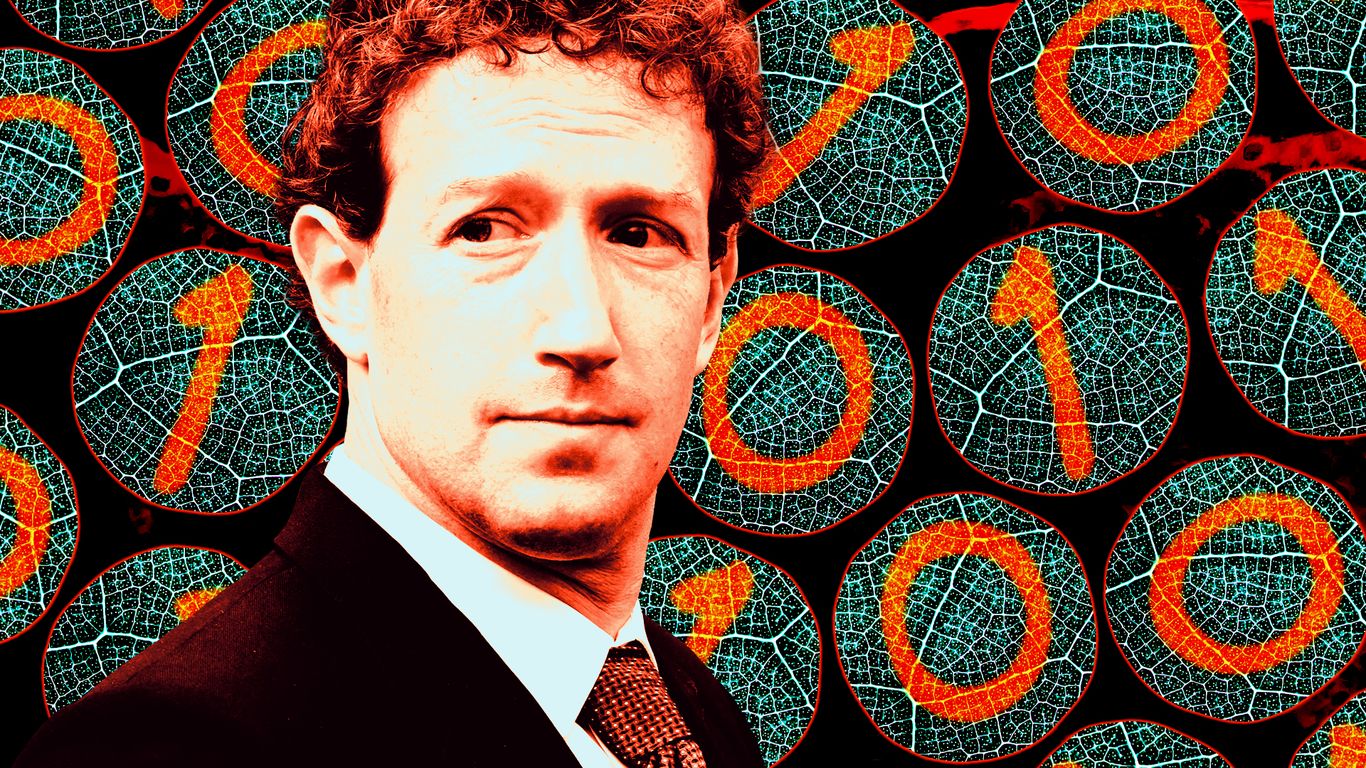
Image via Axios
Zuckerberg Biohub, Google, and the U.S. bet big on a "virtual cell" for AI-driven biology
A new partnership involving the Chan Zuckerberg Biohub, Google, and the federal government is aiming to build what amounts to a “virtual cell”: an AI-enabled system fed by massive amounts of biological data to model how cells behave and, ultimately, to predict how interventions might change outcomes. The pitch is that biology has been data-starved and fragmented; the project’s supporters argue that high-quality, standardized datasets paired with modern AI could compress years of lab work into faster, cheaper iteration.
If it works, the upside is enormous: earlier disease detection, smarter drug discovery, and a more reliable way to test hypotheses before moving into costly animal studies and clinical trials. But the trade-offs are real. The harder problem is not just compute; it’s governing sensitive biomedical data, preventing biased or non-reproducible models from being laundered into “science,” and making sure the benefits don’t concentrate in a small set of elite institutions and corporate partners.
There’s also a political economy angle: public-private research collaborations can accelerate breakthroughs, but they can also raise questions about intellectual property, procurement, and accountability. The public is being asked to trust that the guardrails, access rules, and validation standards will be as ambitious as the science itself—and not bolted on after the hype cycle peaks.
✓ The Bottom Line: This is the kind of moonshot worth attempting, but the slogan “new scientific paradigm” should be treated as a claim to be proven, not a credential. The partnership will earn trust only if it commits up front to rigorous validation, open benchmarking, and clear rules on data rights and model transparency. If the work becomes proprietary by default or irreproducible in practice, it risks turning public support into a subsidy for a few well-positioned players.
📎 Axios

Image via Politico
Obama returns to Michigan trail as Democrats try to steady a turbulent midterm map
Former President Barack Obama is set to campaign in Michigan with Democratic candidates Abdul El-Sayed and Secretary of State Jocelyn Benson, adding his star power to a midterm push that Democrats hope can energize turnout in a high-stakes battleground. The Detroit stop is part of a broader effort by national Democrats to shore up core constituencies while countering Republican messaging on inflation, public safety, and cultural flashpoints.
Obama remains one of the party’s most effective communicators, particularly with younger voters and Black voters, but the political environment is less forgiving than it was a decade ago. Michigan’s electorate is closely divided, and persuasion now hinges less on speeches than on a messy mix of cost-of-living pressures, trust in institutions, and local concerns about schools, crime, and jobs.
For Republicans, the Obama visit is also a gift: a chance to frame Democrats as tethered to national figures and priorities rather than kitchen-table issues. For Democrats, the calculation is straightforward: in close races, a few points of turnout and enthusiasm can matter more than any single policy paper.
✓ The Bottom Line: Obama can still help Democrats, but rallies don’t repeal voter frustration. The party’s best use of him is disciplined: focus on competence, measurable results in Michigan, and a forward-looking economic message that doesn’t sound like scolding. Republicans shouldn’t overreact to celebrity politics either; candidates win when they address prices, safety, and trust with specifics.
📎 Politico

Image via ABC News
Russia unleashes another large overnight barrage as Ukraine warns of widening civilian toll
Russia launched what Ukrainian officials described as a massive overnight attack, with strikes hitting multiple areas and damaging residential buildings, including apartment blocks. President Volodymyr Zelenskyy highlighted the human cost by pointing to an ordinary five-story building among the targets, underscoring the recurring pattern of urban areas absorbing the brunt of long-range strikes.
The latest barrage comes as both sides continue to seek advantages heading into winter, when energy infrastructure and civilian resilience become strategic pressure points. Ukraine has pushed for additional air-defense systems and interceptors, arguing that the limiting factor is not willpower but the math of missiles and drones versus available defenses.
For Western governments, the attack renews the familiar dilemma: sustaining military aid at scale while managing domestic fatigue, budget politics, and escalation anxieties. Moscow appears to be betting that time, terror, and incremental battlefield gains can weaken Ukraine’s backing even if the war remains stalemated.
✓ The Bottom Line: The evidence keeps pointing to a Russian strategy that treats civilian harm as leverage, not collateral damage. The most practical Western response is still air defense, ammunition, and maintenance capacity delivered faster, not just promised louder. Diplomacy matters, but it works best when Ukraine isn’t negotiating under missile fire and interceptor scarcity.
📎 ABC News

Image via The Dispatch
Three years after Oct. 7, antisemitism on campuses remains a test of moral clarity and institutional backbone
Three years after Hamas’ Oct. 7 attack, the U.S. is still wrestling with an ugly resurgence of antisemitism that has shown up in public life and, notably, on college campuses. The argument is not that criticism of Israel is inherently antisemitic—it is not—but that some campus climates have normalized harassment, intimidation, and rhetoric that veers into collective blame or explicit dehumanization of Jews.
Universities often insist they are balancing free expression with student safety, and there are legitimate concerns about overreach and viewpoint discrimination. But the line between protest and targeting is not mysterious: blocking access, threatening language, and singling out students for their identity are violations of basic campus conduct in any other context.
The broader problem is institutional inconsistency. Many schools learned to speak fluently about inclusion and discrimination in recent years; now they are being judged on whether those standards apply when the targeted group is unpopular in certain activist circles or when administrators fear backlash from donors, faculty, or social media mobs.
✓ The Bottom Line: Free speech is essential, but universities don’t get to redefine harassment as “context” depending on the politics of the moment. If a campus can police threats and intimidation in other cases, it can do so here without turning into a censorship machine. The fairest standard is also the simplest: protect lawful protest, punish targeted harassment, and enforce rules evenly—even when it’s inconvenient.

Image via RealClearMarkets
Bitcoin’s rally looks more durable, but the old question remains: at what price?
A market commentary argues that bitcoin’s recent bounce has matured into a longer-term uptrend, suggesting the move is no longer just a short-lived rebound but a shift in broader momentum. For investors, that raises the familiar temptation: chase strength now or wait for a pullback that may never come.
The bullish case tends to hinge on improving technical signals, growing acceptance in parts of finance, and the recurring pattern of cycles where drawdowns eventually give way to new highs. The cautionary case is just as straightforward: bitcoin remains volatile, sensitive to liquidity conditions, and prone to sharp reversals when risk appetite changes or regulatory headlines hit.
For most households and many institutions, the bigger issue isn’t predicting the next move—it’s risk management. Position sizing, time horizon, and custody discipline matter more than any single chart. A “longer-term uptrend” can coexist with 20 to 30 percent swings that punish overconfident buyers.
✓ The Bottom Line: If bitcoin is trending higher, that’s information, not a mandate. The most defensible approach is treating it as a speculative asset: small allocation, clear rules, and no illusions that charts repeal volatility. If you’re asking “is it too late,” the honest answer is that it’s too late to buy irresponsibly, but not too late to build a measured position you can hold through a real drawdown.
That’s the file for today. We’ll keep separating signal from noise—and calling out the trade-offs policymakers and markets would rather glide past.
— Brief Updates Editorial