Today’s Sponsor
Policy shifts are already moving markets in 2026 — trade enforcement, regulatory changes, and tax positioning are redirecting capital flows right now. The stocks benefiting from these trends are showing momentum early, and institutional money is already repositioning.
Our latest research brief breaks down the 5 Best Stocks to Buy Under the Current Administration — including the sectors leading this rotation and a clear framework for acting before the crowd catches on. Markets don't wait for certainty. Don't get left behind.
Get the Free ReportBy clicking the link above, you're choosing to opt in to receive insightful updates from The Investment News Daily + 2 free bonus subscriptions. Your privacy is important to us. You can unsubscribe anytime. See our privacy policy for details.

Oil jumps back above $100 as the UAE says it will leave OPEC, adding fresh uncertainty to Gulf supply dynamics amid Iran-war-linked volatility.

Image via NBC News
UAE Signals Exit From OPEC as Iran War Jitters Push Oil Back Above $100
The United Arab Emirates said it will leave OPEC, a sharp escalation in an already tense Gulf energy picture as fighting tied to the Iran war ripples through markets. Traders reacted quickly: U.S. crude rose above $100 a barrel for the first time since April 10, with prices also pressured by reports that talks involving Iran hit turbulence and by broader fears of supply disruption.
The UAE move underscores a widening rift inside producer alliances over quotas, capacity, and national interests. Abu Dhabi has long argued it should be allowed to pump more based on its investments, while the cartel has aimed to manage supply tightly to support prices. With the region’s security situation deteriorating, any sign of fragmentation among major exporters tends to amplify volatility — and adds uncertainty for importers already grappling with inflation-sensitive energy costs.
Read the full story at NBC News →

Image via The Hill
Tech Layoffs Rise in the “AI Era” — But Capex, Restructuring, and Rate Reality Matter More
A new wave of tech layoffs is being widely framed as “AI replacing workers,” but the available evidence suggests a more complicated story: companies are reshaping budgets toward AI infrastructure and away from slower-growth or duplicative lines of business. In many cases, cuts appear driven less by direct automation and more by reallocating investment — shifting headcount, pausing projects, and tightening operating costs after years of hiring ahead of demand.
Higher interest rates and tougher capital markets continue to reward profitability over expansion, especially for firms that previously relied on cheap money. AI can accelerate that transition by changing what firms choose to fund, but it’s not always the proximate cause of job losses. The takeaway for workers and policymakers is that “AI layoffs” often reflect a strategic reset — and a bargaining environment where management has more leverage than it did during the post-pandemic hiring boom.
Read the full story at The Hill →
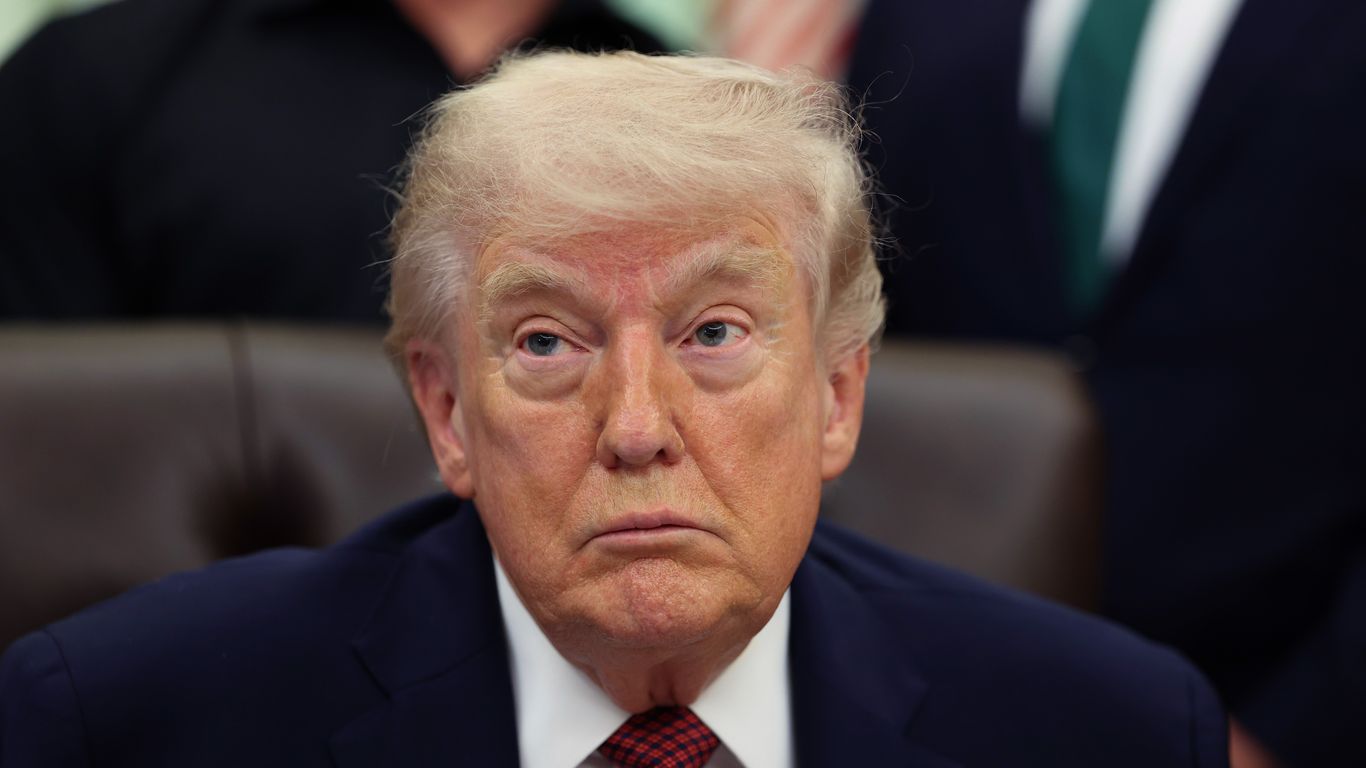
Image via Axios
Trump Says Iran Wants Strait of Hormuz Reopened “ASAP,” Claims Tehran Is “In Collapse”
President Trump said Tuesday that Iran has told the U.S. it wants the Strait of Hormuz opened “as soon as possible,” and claimed Iran is “in a state of collapse.” The remarks come as global markets remain fixated on shipping risk in the Gulf, where even limited disruption can spike insurance costs, reroute cargo, and raise energy prices worldwide.
Axios notes the claim is difficult to verify independently, and the administration has not publicly provided corroborating details about the communication channel, timing, or terms. Still, the statement fits the strategic moment: Washington is trying to project leverage while signaling that de-escalation — especially around shipping lanes — remains a core objective for allies and global energy consumers.
Read the full story at Axios →
Reuters: Trump Team Presses State-by-State Election Control Effort, Raising Federalism and Legitimacy Fights
President Trump and allies are pursuing a state-by-state strategy aimed at expanding influence over how elections are administered, according to Reuters, leaning on a mix of legislation, executive pressure, and legal arguments about state authority. The effort is unfolding across multiple battlegrounds where rules governing voter registration, ballot handling, and certification procedures can shift outcomes at the margins — and where election administration has become a front-line partisan conflict.
Supporters argue the push is about tightening standards, restoring confidence, and countering what they describe as weak controls that invite error or abuse. Critics contend it risks politicizing election machinery, chilling participation, and undermining the independence of officials charged with administering results. The broader implication is a prolonged legitimacy fight: even incremental procedural changes can trigger litigation, federal-state clashes, and renewed distrust in close contests.
Read the full story at Reuters →
GM Lifts 2026 Outlook After $500M Tariff Refund, Tops Estimates as War-and-Tariff Risks Loom
General Motors beat Wall Street expectations and raised its 2026 guidance, helped in part by a roughly $500 million tariff-related refund, according to CNBC. Investors are closely watching how GM navigates a volatile mix: Iran-war-driven energy uncertainty, the direction of trade policy and tariffs, and ongoing cost discipline as automakers calibrate EV spending after write-downs and uneven demand.
The refund provides a one-time boost, but the bigger question is durability — whether GM can protect margins amid pricing pressure, supply-chain fragility, and potential demand softening if financing costs stay high. Markets also remain attentive to how legacy automakers balance shareholder returns with capital-intensive transitions in software, batteries, and advanced manufacturing.
Brief Updates — Fair-minded reporting, sharp context, no spin.
— Brief Updates Editorial