Today’s Sponsor
Tax season creates hidden market shifts that can mislead investors. Refunds hit accounts, portfolios get rebalanced, and positions move to cover obligations — creating liquidity changes that make small-cap moves appear more meaningful than they actually are.
Our 2026 Market Flow Briefing reveals how tax-season liquidity affects market action, why current moves seem disconnected from fundamentals, and exposes one profitable setup emerging under these exact conditions.
Get the Free Briefing*We encourage readers to perform their own research and due diligence on any information we provide. By clicking the link you will automatically be subscribed to the Stock Wire News Newsletter.

Monday, June 15, 2026 — A tentative agreement emerges in the Middle East as Trump heads to the G7, SpaceX makes a historic debut, and courts reshape the semiconductor landscape.
Image via Associated Press
U.S. and Iran Reach Tentative Deal to End Hostilities as Israel Complicates Path Forward
The United States and Iran have reached a preliminary agreement to end their five-month military confrontation, according to sources briefed on the negotiations. The tentative deal would see Iran halt attacks on U.S. assets and allied shipping in exchange for sanctions relief and resumed oil sales. However, the agreement faces an immediate complication: Israel has announced it will not withdraw from Iranian territory it has occupied during the conflict, raising questions about whether Tehran will accept terms that leave Israeli forces on its soil.
The conflict, which began in January 2026 following a series of escalating maritime incidents in the Persian Gulf, has disrupted global oil markets and strained U.S. relations with both Middle Eastern allies and European partners. The Biden administration initially responded with targeted strikes against Iranian Revolutionary Guard facilities, but the conflict expanded as Iran-backed proxies launched attacks across the region. Recent Israeli airstrikes in Lebanon, including Sunday's hit on residential areas in Dahiyeh, have added another layer of complexity to regional de-escalation efforts.
Diplomats cautioned that the agreement remains fragile and subject to last-minute changes. The deal's success may hinge on whether mediators can broker a separate understanding between Israel and Iran regarding the occupied territories, or whether the U.S. can persuade its ally to make territorial concessions as part of a broader regional settlement.
Read the full story at Associated Press →
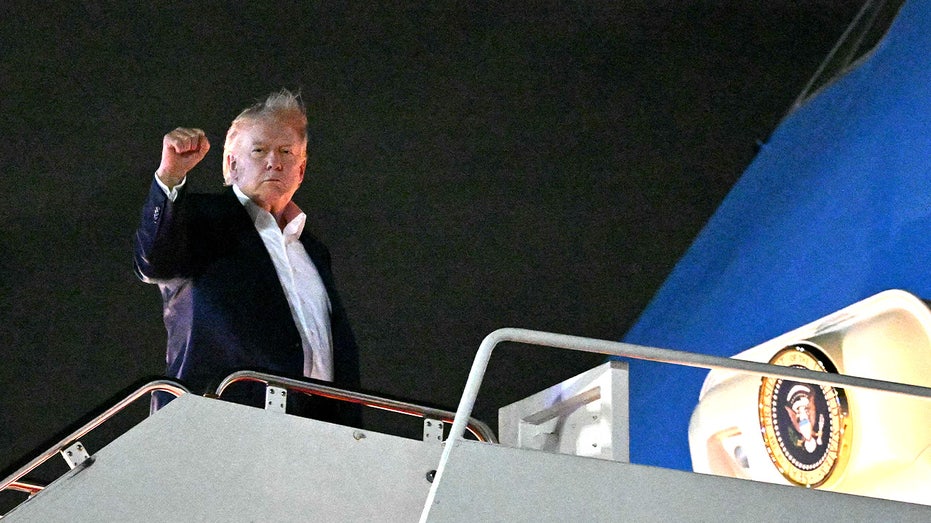
Image via Fox News
Trump Arrives at G7 Summit With Iran Win in Hand, Trade Battles Ahead
President Trump departed for the G7 summit in Italy on Monday carrying momentum from the tentative Iran deal but facing contentious discussions on trade policy with America's closest allies. The gathering in Rome will focus on artificial intelligence governance, reducing dependence on Chinese manufacturing, and NATO burden-sharing—all issues where Trump's "America First" approach has created friction with European and Canadian counterparts.
Trade disputes are expected to dominate sidebar conversations, particularly regarding Trump's proposed reciprocal tariffs on European goods and his demands that NATO allies increase defense spending to 3% of GDP. German Chancellor Friedrich Merz has already signaled opposition to what he called "unilateral" trade measures, while French officials have indicated they will push back on any attempts to weaken multilateral climate commitments. Trump administration officials counter that the president is simply demanding fairness in trade relationships that have disadvantaged American workers for decades.
The summit also provides Trump an opportunity to leverage the Iran agreement as evidence of his foreign policy effectiveness. White House sources suggest the president will argue that strength and unpredictability in negotiations—rather than the traditional diplomatic approach—produced results where previous administrations failed. Whether G7 partners view the Iran deal as vindication of Trump's methods or simply fortunate timing remains to be seen.
Read the full story at Fox News →
SpaceX Debuts at $2 Trillion Valuation, Igniting Debate Over Space Economy's Future
SpaceX shares surged 6% in premarket trading Monday following the company's record-breaking public debut, pushing its market capitalization above $2 trillion and making it the fourth most valuable publicly traded company in the United States. The valuation surpasses that of every aerospace and defense contractor combined, reflecting investor enthusiasm for the company's dominance in commercial spaceflight, satellite internet through Starlink, and its ongoing lunar and Mars programs.
The IPO, which raised $47 billion in the largest public offering in history, comes as SpaceX holds contracts worth over $15 billion with NASA and the Department of Defense. The company now launches approximately 80% of all global payload mass to orbit and operates more than 9,000 Starlink satellites providing internet service to 12 million subscribers worldwide. CEO Elon Musk, who retained a 42% stake in the company, briefly became the world's first trillionaire based on his combined holdings before share prices moderated slightly in early trading.
Analysts remain divided on whether the valuation is justified. Bulls point to SpaceX's near-monopoly on reliable heavy-lift launch services, its reusable rocket technology that has reduced launch costs by 90%, and the potential for Starlink to generate $50 billion in annual revenue within five years. Skeptics warn that the company's Mars ambitions remain speculative, competition from China's space program is intensifying, and regulatory challenges could constrain Starlink's growth in key markets.
Russian Strike Hits Historic Kyiv Monastery in What Ukraine Calls 'Crime Against Christian Culture'
A Russian missile strike severely damaged the Kyiv-Pechersk Lavra, an 11th-century monastery complex and UNESCO World Heritage site, in an attack early Sunday morning that Ukrainian officials condemned as a deliberate assault on Christian heritage. The strike damaged the monastery's cathedral and destroyed portions of the complex that have stood for nearly a millennium, killing three monks and injuring at least twelve others. The Lavra, founded in 1051, is considered the spiritual heart of Eastern Orthodox Christianity and houses irreplaceable religious artifacts and frescoes.
Russia's Defense Ministry denied responsibility for the strike, claiming without evidence that Ukrainian air defense missiles caused the damage. This explanation mirrors Moscow's response to previous strikes on civilian and cultural sites throughout the conflict. International observers and weapons experts who reviewed video footage of the attack identified the incoming weapon as consistent with Russian Iskander-M missile systems, based on the projectile's flight characteristics and explosive signature.
The attack drew swift condemnation from religious leaders worldwide, including a rare public statement from Pope Francis calling the destruction "an assault on the soul of Europe." The Orthodox Church in Ukraine, which has maintained an uneasy relationship with both Moscow and Kyiv since its split from Russian ecclesiastical authority in 2019, issued a statement declaring the strike evidence of Russia's "war against faith itself." The incident is likely to further harden Western resolve on military aid to Ukraine, particularly among European nations where the cultural dimension of the conflict resonates powerfully.
Read the full story at Newsweek →
Image via South China Morning Post
Chinese Chip Stocks Rally After Supreme Court Upholds Infineon Patent Ban
Shares of Chinese semiconductor manufacturers surged Monday following the U.S. Supreme Court's decision to let stand a lower court ruling that blocks German chipmaker Infineon Technologies from selling gallium nitride (GaN) products in mainland China. The decision, which the Court declined to review without comment, upholds a Chinese court's finding that Infineon violated patents held by Chinese firms in the strategically important compound semiconductor sector. Leading Chinese GaN manufacturers saw stock prices jump between 8% and 15% in Shanghai trading on expectations of reduced foreign competition.
Gallium nitride semiconductors represent a critical technology for power electronics, 5G infrastructure, and electric vehicle systems—all sectors where China seeks technological self-sufficiency. The patent dispute centers on manufacturing processes for GaN-on-silicon wafers, with Chinese firms claiming Infineon infringed on techniques developed by domestic researchers. Infineon has contested the validity of the underlying patents and suggested the case reflects China's broader industrial policy of using intellectual property litigation to protect domestic champions while restricting foreign competitors.
The Supreme Court's decision not to intervene carries implications beyond this specific case, potentially signaling judicial reluctance to override foreign patent determinations even when U.S. companies and allies are affected. Trade experts note the ruling creates asymmetry in semiconductor markets: while Chinese firms gain protection in their home market, they continue to face restrictions on advanced chip imports under U.S. export controls. The decision may accelerate Western efforts to build entirely separate technology supply chains that bypass Chinese manufacturing and markets.
Read the full story at South China Morning Post →
That's your Brief Update for Monday, June 15, 2026. We'll be watching how the Iran deal holds up under Israeli pressure, whether Trump's G7 charm offensive survives contact with tariff reality, and what SpaceX's valuation says about where smart money sees the future. Stay informed.
— Brief Updates Editorial