Today’s Sponsor
That "Trump Bump" Social Security raise? Already gone. Medicare premiums, gas, groceries — they've swallowed every penny before it hits your account. Meanwhile, your benefits have already lost 13.7% of their purchasing power since 2016, and the system would need to raise checks by 15.7% just to break even. You're getting $81. You needed $296.
Central banks have been quietly buying one specific asset at the fastest pace in 50 years — and JP Morgan now sees it hitting $8,000. Smart retirees aren't waiting on the next COLA. They're protecting what's left right now. Get the free guide and see the 3 steps disciplined retirees are using to outrun the inflation Washington can't stop.
Get the Free Wealth Preservation GuideThis is an advertisement from First Ballot. If you no longer wish to receive First Ballot promotionals, please let us know. Or write to: 5005 Lyndon B. Johnson Fwy. Suite 350, Dallas, TX 75244

A proposed Putin-Trump-Xi meeting raises hard questions about leverage; U.S. yields cling to a new reality; tech tries to bounce after a brutal week; Macron keeps his interior minister amid riots; and Ukraine’s strikes show how modern war can reach into daily life.

Image via The Hill
Putin Floats a Trump-Xi Summit on Ukraine, Testing Who Has Leverage
Russian President Vladimir Putin is proposing a three-way meeting next month with President Trump and Chinese President Xi Jinping to discuss ending the war in Ukraine, according to reporting citing the Wall Street Journal. The outreach is aimed at elevating talks to the top political level and placing Russia, the U.S., and China at the center of any diplomatic outcome.
A summit framework like this carries obvious risks for Kyiv and Europe: it can sideline the parties actually doing the fighting and paying the costs, and it can reframe the war as a great-power bargain rather than an invasion with clear responsibility. Supporters will argue that only leaders can cut through bureaucratic stalemate; critics will note that Russia has repeatedly used talks to buy time, split coalitions, and lock in territorial gains without meeting basic conditions.
If this proposal gains traction, the immediate questions are what each leader would demand as a price for attendance, and whether Ukraine’s sovereignty and security guarantees are treated as non-negotiable or as bargaining chips. China’s role matters, too: Beijing has leverage over Moscow, but also strategic incentives to see the U.S. distracted and Europe divided.
✓ The Bottom Line: A leader-level meeting is not inherently bad, but the structure matters: if Ukraine isn’t in the room and the agenda isn’t anchored to verifiable steps, it’s more likely to legitimize Russia’s position than to end the war. Putin is signaling he wants a deal that freezes gains; Washington should treat that as the baseline assumption, not a breakthrough. Any summit should be conditioned on concrete commitments first, not promises made under the cameras.
📎 The Hill
The 10-Year’s New Floor: Hot Inflation Keeps Yields Elevated as AI Hype Cools
Long-term U.S. Treasury yields remain volatile with the 10-year yield treating 5 percent less like a ceiling and more like a floor, amid persistent inflation pressure and signs of strain in the AI-driven market narrative, according to Wolf Street. The point is not just the day-to-day moves, but the apparent regime change after years when markets assumed inflation would glide back to target and rates would follow.
Higher long-term yields tighten financial conditions across the economy, raising borrowing costs for mortgages, corporate debt, and government financing. The same dynamic also challenges equity valuations that were built on low discount rates, especially for growth sectors that depend on far-off earnings.
Wolf Street frames the current tension as a mix of stubborn inflation realities and cracks in “AI mania” that had supported risk appetite. If investors increasingly believe inflation is sticky, the market’s old habit of pricing quick Fed relief becomes harder to justify, and rate-sensitive assets face a more durable headwind.
✓ The Bottom Line: Markets spent years training themselves to expect falling yields at the first sign of stress, and that reflex is now colliding with inflation that won’t politely disappear. If 5 percent really is the neighborhood for the 10-year, policymakers and investors need to act like it: fiscal discipline matters more, and speculative valuations deserve less benefit of the doubt. The “new normal” story may be overstated, but the burden of proof has shifted.
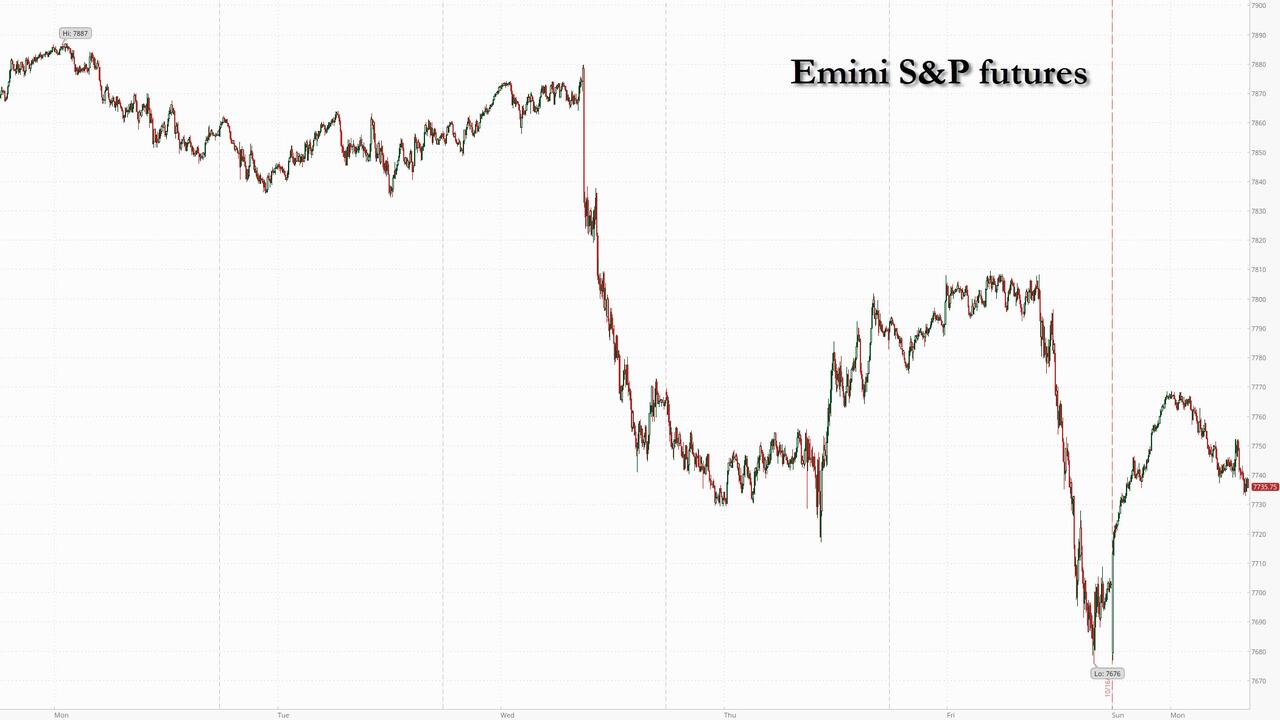
Image via ZeroHedge
After a Brutal Nasdaq Week, Chip Dip-Buying Returns as Futures Rebound
U.S. stock futures moved higher as buyers stepped back into semiconductor names after the Nasdaq suffered its worst week since a prior market shock referred to as “Liberation Day,” according to ZeroHedge. The move points to a familiar pattern: sharp tech selloffs often attract dip-buyers, particularly in liquid, heavily-owned chip leaders.
Still, the rebound comes with a larger backdrop of elevated rates, inflation uncertainty, and a growing debate about whether AI-driven growth expectations got ahead of underlying profits. When yields stay high, the market’s tolerance for richly priced growth stories typically narrows.
The near-term test is whether this is a tradable bounce or a genuine stabilization. If macro data keeps pushing rates upward, rallies in long-duration tech may remain fragile even if the fundamental AI buildout continues.
✓ The Bottom Line: Dip-buying is not a thesis; it’s a tactic, and it works until the macro tape changes enough that valuations have to reset. Chips may still be central to the AI buildout, but that does not immunize them from a higher-rate world or from over-ownership. A rebound is plausible, yet investors should demand clearer earnings support before treating last week’s selloff as merely a hiccup.
Macron Keeps Interior Minister After Riot Weekend, Betting on Control Over Concessions
French President Emmanuel Macron refused the resignation of Interior Minister Laurent Nuñez after a weekend of violent riots, according to Breitbart. The decision signals an effort to project stability and continuity in the security apparatus rather than accept a high-profile resignation amid public anger.
Keeping Nuñez can be read as a vote of confidence in the government’s policing strategy, or as a refusal to offer political accountability for failures to prevent or contain unrest. Either way, France is again confronting the difficult balance between maintaining public order and preserving civil liberties during mass disturbances.
The political impact will hinge on whether violence subsides and whether the government can credibly address underlying grievances without appearing to reward lawlessness. European governments watching closely know that repeat cycles of riots and heavy-handed response can feed polarization on both ends of the spectrum.
✓ The Bottom Line: Refusing a resignation can be the right call if it’s paired with measurable changes and transparency, not just a demand for tougher enforcement. France needs order, but it also needs honest accounting when the state loses control of the streets. Macron is betting that firmness will restore confidence; that bet only pays off if the government proves it can deliver security without drifting into impunity.

Image via NBC News
Ukraine’s Data Center Strikes Hit Russians’ Daily Lives, Expanding War’s Digital Battlefield
Ukrainian strikes on data centers linked to Russia’s internet giant Yandex left millions of Russians facing disruptions that reached into daily routines, from accessing bank accounts to ordering taxis and food, NBC News reports. The impact underscores how modern war increasingly targets infrastructure that blurs civilian convenience and national capability.
For Ukraine, digital and logistical chokepoints can be a way to impose costs beyond the front lines, especially when conventional asymmetries favor Russia in manpower and depth. For Russia, the disruptions highlight vulnerabilities in centralized platforms and data infrastructure, and they invite pressure for retaliation in a domain where escalation can be hard to control.
The legal and moral terrain is complicated: data centers can serve civilian services and also support state functions, surveillance, or military logistics. As both sides probe critical systems, the risk grows that ordinary people will bear more of the immediate pain, even when they are far from the battlefield.
✓ The Bottom Line: Targeting enabling infrastructure can be militarily rational, but the closer attacks get to core civilian systems like banking access, the higher the bar should be for necessity and proportionality. Ukraine has a legitimate right to defend itself and impose costs on the aggressor, yet strategies that predictably lock civilians out of essential services risk undermining international support. The deeper lesson is that Western countries should treat data resilience as national security, not just IT housekeeping.
📎 NBC News
That’s the report for Monday. We’ll be watching whether summit talk produces conditions or just headlines, and whether markets are adjusting to higher yields as a reality rather than a temporary scare.
— Brief Updates Editorial