Today’s Sponsor
The midterms are behind us — but market uncertainty isn't. Options premiums can look attractive right now, yet the obligations behind them demand equal attention. Assignment risk, capped upside, and capital requirements don't disappear just because the premium looks good.
Our free Income Strategies with Options guide breaks down the mechanics clearly — obligations beside potential income, downside mapped before any trade. The premium is visible immediately; the obligation may arrive later. Read the guide before a tempting quote becomes a costly position.
Send Me the Free ReportBy clicking this link you agree to receive emails from StockEarnings and our affiliates. You can opt out at any time. Privacy Policy.

Wednesday, November 11, 2026 | Brief Updates On Veterans Day, we pause to thank the men and women who served, and the families who carried the load at home. Honor is not a hashtag: it is care, accountability, and keeping faith with the promises made when the uniform went on.
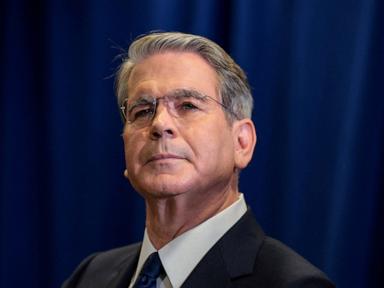
Image via ABC News
Treasury Secretary Bessent reportedly relocates to military base amid security considerations
Treasury Secretary Scott Bessent has moved from his residence in Washington’s Georgetown neighborhood to a military base, according to sources cited by ABC News. The report does not describe a public incident triggering the move, but such relocations typically follow updated threat assessments or a decision to consolidate protective logistics.
High-ranking Cabinet officials routinely receive enhanced protection, yet a shift from a private home to a base is unusual enough to raise questions about the severity or specificity of the concern. The move also lands in a broader climate of elevated political tension, including online harassment and threats directed at public officials, which has pushed agencies to take a harder line on security posture.
If the relocation is driven by credible threats, it underscores how domestic security pressures are no longer abstract for senior leadership, even outside the national security portfolio. If it is primarily a protective-services decision made out of abundance of caution, the public still deserves clarity to the extent operational security allows, because the cost and precedent matter.
✓ The Bottom Line: Washington should not normalize a world where Cabinet officials need to live on bases to do their jobs. If there is a credible, actionable threat stream, the government should say that plainly without disclosing details that aid attackers. And if it is merely optics-free convenience, officials should be candid about that too, because trust erodes when basic facts are left to rumor.
📎 ABC News

Image via Fortune
Rox raises big at a big price, pitching AI sales software as a real Salesforce challenger
Rox, an AI-focused sales startup, has raised a $100 million Series B at a reported $1.3 billion valuation, according to Fortune. The company is betting that automation and AI-native workflows can rewire how sales teams prospect, manage pipelines, and forecast, with ambitions that put it in direct rhetorical competition with Salesforce’s long-dominant CRM ecosystem.
The pitch is familiar in outline: less manual data entry, smarter lead prioritization, faster follow-ups, and more accurate forecasting by using AI to digest emails, calls, and customer activity. The question, as always, is whether the product actually integrates cleanly with the messy realities of enterprise selling, compliance requirements, and the entrenched systems that already sit inside most large companies.
A $1.3 billion valuation this early signals investor belief that incumbents are vulnerable to platform shifts. But it also raises the bar for execution: enterprise software winners need security maturity, reliable uptime, defensible differentiation, and a sales motion that can survive longer buying cycles as budgets tighten and procurement gets tougher about AI risk.
✓ The Bottom Line: The story here is less “AI will replace Salesforce” and more “buyers are fed up with expensive, cluttered tool stacks.” Rox can win if it reduces complexity and proves ROI under real governance constraints, not demo-day conditions. The valuation assumes it can do that at scale; investors may be right, but the margin for hype is shrinking fast in enterprise AI.
📎 Fortune

Image via Fox Business
Toy soldiers, re-made in America: a small business ties a classic to real veteran stories
A company is revamping classic toy soldiers with an American-made production model and a mission: turn real veterans into plastic figures that preserve their stories, according to Fox Business. The concept blends nostalgia with commemoration, positioning the product as both a collectible and a conversation starter about service and sacrifice.
There is also a manufacturing angle that resonates in 2026: bringing a simple, tangible product back to domestic production as supply chains, tariffs, and geopolitical risk keep pushing companies to rethink where things get made. If executed well, it is a reminder that “made in the USA” can be more than branding when it is tied to craftsmanship, transparency, and community employment.
On Veterans Day, the idea lands with extra weight. Honoring service is not only about ceremonies; it is about keeping stories alive in a way that reaches families and kids without turning veterans into props. Done respectfully, storytelling products can help bridge a civil-military gap that is too often ignored until the next crisis.
✓ The Bottom Line: This is the kind of private-sector tribute that works when it is grounded in dignity and accuracy. The risk is commercialization that slides into kitsch, so the company’s standards and veteran involvement matter more than the marketing. If it genuinely preserves stories and supports veterans in a concrete way, it deserves attention beyond holiday sentiment.

Image via NTD
Dozens charged in multi-state drug case; feds say some defendants are in the country illegally
Federal prosecutors have charged 36 people in a multi-state drug trafficking case, including nine described as illegal aliens, according to NTD. The report points to a law-enforcement operation involving the FBI and Justice Department, part of the broader push to disrupt distribution networks that fuel overdose deaths and related violence.
Multi-defendant trafficking cases typically involve layered roles—sourcing, transport, stash locations, money movement, and retail distribution—and are built on a mix of surveillance, informants, controlled buys, and digital evidence. When immigration status becomes part of the public narrative, it can quickly turn the case into a proxy fight over border policy rather than a clear look at the specific criminal network being alleged.
The core policy issue remains twofold: enforcement capacity against organized drug networks, and the upstream conditions that allow repeat offenders and transnational supply chains to operate. The immigration detail is relevant, but it does not explain the entire problem, nor does it absolve domestic demand, local distribution, and prosecutorial choices that shape deterrence.
✓ The Bottom Line: If the government can prove these charges, the public interest is straightforward: dismantle the network and keep dangerous players off the street. It is also fair to say that weak immigration enforcement can widen the pool of exploitable labor for criminal organizations, and that reality should not be taboo. But serious policymaking cannot reduce the fentanyl-era drug crisis to a single variable; enforcement, treatment, and border security all have to be treated as linked, not competing, priorities.
📎 NTD
Axo Metals boosts bought-deal financing to $55 million as funding window stays selective
Axo Metals Corp. announced an upsize of its previously announced bought-deal financing to $55 million, according to a release carried by Business Insider. In a bought deal, underwriters commit to purchasing the offering, providing the issuer more certainty on proceeds while shifting more immediate placement risk to the dealers.
An upsize can signal healthy demand or improved terms versus initial expectations, though it is not a blanket indicator of long-term strength. Investors will still want the practical details: use of proceeds, balance-sheet impact, dilution, and whether the capital is aimed at near-term operations, acquisition strategy, or expansion plans that can realistically clear regulatory and market hurdles.
The bigger context is that capital markets remain uneven. High-quality stories can still raise money, but investors are scrutinizing cash burn, unit economics, and execution risk more tightly than they did in the easy-money years. Companies tapping markets now need to show not only growth potential, but credible discipline.
✓ The Bottom Line: An upsize is a good sign that someone is willing to write a bigger check, but it is not proof the underlying business is de-risked. Readers should treat financing headlines as a starting point and look for how the money changes the company’s operating reality: timeline, costs, and measurable milestones. In today’s market, transparency on proceeds and dilution is what separates a real fundraise from a flashy press release.
That’s Brief Updates for Wednesday. To every veteran reading: thank you for serving, and to every family member who carried the quiet burden alongside them, we see you. We’ll be back tomorrow with the facts, the context, and the implications.
— Brief Updates Editorial