Today’s Sponsor
That "Trump Bump" Social Security raise? Already gone. Medicare premiums, gas, groceries — they've swallowed every penny before it hits your account. Meanwhile, your benefits have already lost 13.7% of their purchasing power since 2016, and the system would need to raise checks by 15.7% just to break even. You're getting $81. You needed $296.
Central banks have been quietly buying one specific asset at the fastest pace in 50 years — and JP Morgan now sees it hitting $8,000. Smart retirees aren't waiting on the next COLA. They're protecting what's left right now. Get the free guide and see the 3 steps disciplined retirees are using to outrun the inflation Washington can't stop.
Get the Free Wealth Preservation GuideThis is an advertisement from First Ballot. If you no longer wish to receive First Ballot promotionals, please let us know. Or write to: 5005 Lyndon B. Johnson Fwy. Suite 350, Dallas, TX 75244

Tuesday, September 29, 2026: AI’s biggest player is scaling fast, the White House faces another First Amendment test, Trump leans into manufacturing and tech optics, and housing data sends a split-screen message.

Image via Axios
Axios: OpenAI’s annual recurring revenue approaches $70B as enterprise demand accelerates
OpenAI’s annual recurring revenue is nearing $70 billion, according to sources familiar with the company’s financials cited by Axios. The report says enterprise sales have more than doubled since July, a pace that suggests large organizations are standardizing around a small number of foundation-model providers rather than treating AI as a scattered set of experiments.
If accurate, the figure underscores how quickly AI has moved from pilot projects to recurring, budget-line spending. It also raises the stakes for rivals and regulators: a company that becomes the default layer for workplace productivity, customer service, and software development can quickly acquire platform-like influence, even if it doesn’t look like a traditional consumer monopoly.
The revenue story also points to second-order effects: surging demand for compute, stronger bargaining power with cloud partners, and a widening gap between firms that can afford best-in-class models and those left with cheaper, less capable alternatives. Expect tougher questions about reliability, data governance, and security as adoption spreads beyond tech-forward companies into heavily regulated sectors.
✓ The Bottom Line: A $70B ARR run-rate would be a sign that the AI arms race is already becoming a procurement reality, not a hype cycle. That’s good for productivity, but it also concentrates risk: when one model layer is everywhere, failures, bias, or security flaws scale instantly. Policymakers should focus less on grandstanding and more on enforceable standards for audits, incident reporting, and enterprise-grade data controls.
📎 Axios
Banned outlets ask judge to keep blocking Trump’s White House press ban as case continues
CNN, Politico, and MS NOW asked a federal court to extend an order blocking the Trump administration’s ban of their journalists from White House grounds while litigation proceeds, according to CBS News. The outlets argue the exclusion amounts to viewpoint discrimination and retaliation that interferes with routine newsgathering.
The White House has defended its authority to control access and enforce credentialing rules, a power presidents of both parties have exercised. But courts have generally been skeptical when access decisions look punitive or politically targeted, particularly when the government is choosing winners and losers among similarly situated journalists.
Beyond the legal fight, the practical implication is precedent: if a White House can selectively bar critical outlets without clear, neutral standards and due process, future administrations will be tempted to do the same. That would steadily turn press access into a loyalty test, weakening transparency and increasing reliance on unofficial leaks and staged messaging.
✓ The Bottom Line: The government can set rules for space, safety, and logistics, but it should not be in the business of punishing coverage. If the administration believes specific reporters violated neutral standards, it should publish those standards, document the violation, and offer an appeal process. Courts should be cautious about micromanaging press access, but they should also be firm that viewpoint-based bans are incompatible with a free press.
📎 CBS News

Image via Fox Business
Trump plans surprise visit to Texas Peterbilt plant to spotlight manufacturing and tariff strategy
President Trump will make a surprise stop Thursday at a Peterbilt truck factory in Texas to tout manufacturing, tariffs, and what the White House describes as gains tied to its economic agenda, Fox Business reports. The visit is designed to emphasize factory jobs and domestic production, themes Trump has returned to repeatedly as both policy and political messaging.
Supporters argue tariffs and reshoring pressure have improved bargaining leverage, attracted investment, and protected strategically important industries. Critics counter that tariffs can raise input costs, invite retaliation, and ultimately show up as higher prices for consumers and businesses—especially for complex supply chains that can’t be fully domestic overnight.
For the trucking and heavy-equipment ecosystem, the details matter: whether parts and steel costs stabilize, whether demand holds up if borrowing costs stay elevated, and whether regulatory and infrastructure policy keeps pace. A plant visit is symbolism; the long-run test is whether productivity, training, and predictable rules make American manufacturing durable rather than episodic.
✓ The Bottom Line: Manufacturing strength is a legitimate national interest, but tariffs are a blunt instrument that often conceal trade-offs. If the White House wants this argument to land beyond its base, it needs transparent scorekeeping: jobs gained versus costs passed through, investment that’s truly new versus relabeled, and clear off-ramps when tariffs stop serving the national interest. A factory backdrop can’t substitute for measurable outcomes.
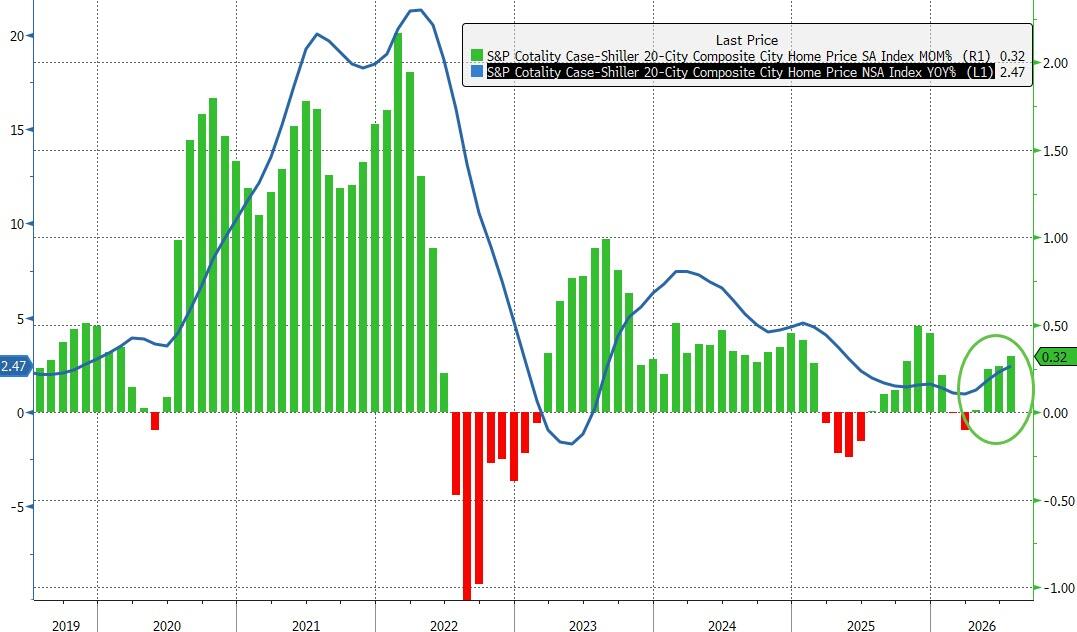
Image via ZeroHedge
Home prices re-accelerate, but the housing market’s internal gauges look uneven
U.S. home prices are rising at their fastest pace in more than a year, according to a ZeroHedge write-up that points to a renewed acceleration even as mortgage rates remain high. The piece emphasizes the tension between firm resale pricing and other indicators that suggest strain beneath the surface.
High financing costs typically cool demand, yet supply remains tight in many regions, particularly for existing homes where owners are reluctant to give up low-rate mortgages. That “lock-in” effect can keep prices elevated even when affordability deteriorates, pushing would-be buyers into rentals or into smaller homes farther from job centers.
At the same time, parts of the new-home market can move differently: builders may cut prices or offer incentives to clear inventory, and the mix of homes being sold can distort topline price metrics. The result is a market that can look hot in aggregate while feeling sluggish on the ground—fewer transactions, more concessions, and a widening gap between desirable metros and weaker ones.
✓ The Bottom Line: A faster pace of price gains in this rate environment is less a sign of a healthy market than a sign of constrained supply colliding with basic shelter demand. That’s not a bubble story as much as a policy failure: local restrictions, slow permitting, and infrastructure bottlenecks keep inventory scarce. The right focus is expanding supply and easing the path to build, not pretending interest rates alone can fix housing affordability.

Image via NTD
Trump to unveil America.gov portal and meet tech leaders in push to modernize federal digital front door
President Trump is set to unveil an America.gov portal and meet with tech leaders, according to NTD. The initiative is framed as a modernization effort for how the public navigates government services and information—an attempt to consolidate what is currently spread across a maze of agency sites and logins.
In theory, a single front door can improve usability, reduce paperwork friction, and help citizens complete routine tasks more quickly. In practice, federal digital projects often stumble on scope creep, procurement complexity, and security requirements that private-sector teams don’t face to the same degree.
The key questions will be governance and trust: how identity is verified, what data is shared across agencies, whether the portal becomes a centralized target for breaches, and whether content and search results are handled neutrally rather than shaped by politics. A “one-stop shop” can be a real public service—or a high-profile boondoggle—depending on execution discipline and transparency.
✓ The Bottom Line: A simpler federal digital front door is a good goal, and it’s overdue. But centralization amplifies risk, so the administration should prioritize security architecture, minimal data collection, and independent oversight from day one. If America.gov becomes more about branding than functionality, it will fail; if it’s built around measurable service improvements and tight controls, it could be one of the more practical reforms this White House delivers.
📎 NTD
That’s the file for today: big money in AI, big stakes in press freedom, and a housing market that refuses to behave the way textbooks say it should. We’ll be watching what’s real versus what’s just optics—on both left and right.
— Brief Updates Editorial