In partnership with

Yes, that Arnold Schwarzenegger.

He has a newsletter on beehiiv. So do Codie Sanchez, Jay Shetty, David Begnaud, Colin & Samir, and Joanna Stern.
They could publish just about anywhere. They chose beehiiv to build a direct connection with the people who want to hear from them most. And you can do the same, whether you’re world-famous or just at the start of your plan for world domination.

Tuesday’s lineup: Nvidia reports as investors price a post-Huang future; the Defense Department fails audit No. 9; Ukraine hits the Crimean bridge again; Iran claims another strike on a U.S. site in Bahrain; and the UK targets Israeli settlement-linked construction firms.
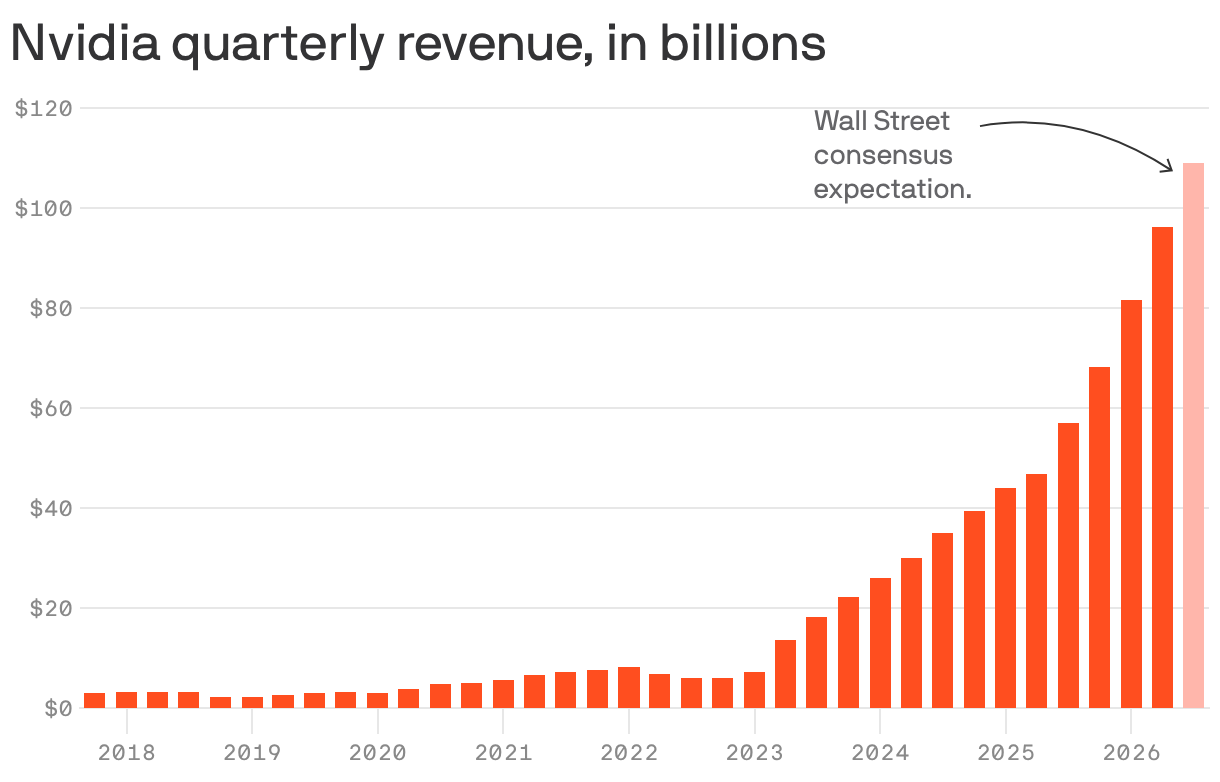
Image via Axios
Nvidia reports as Wall Street starts pricing the post-Jensen era
Nvidia reports third-quarter results after Tuesday’s close, and this one lands with a different weight: investors are no longer just modeling demand for AI chips, they’re modeling what Nvidia looks like without Jensen Huang at the center of every product cycle, customer pitch, and strategic turn. The company’s story has been unusually founder-driven for a firm of its size, and leadership transitions tend to expose where execution is institutional and where it’s personal.
The near-term numbers still matter most: data center revenue trajectory, supply constraints, gross margins under the pressure of fierce capex and packaging bottlenecks, and guidance that signals whether hyperscalers are still in an arms race or entering digestion. But listen even harder for what management says about platform lock-in, software monetization, and competitive threats from AMD, custom silicon at the cloud giants, and a China market that remains constrained by export controls.
In other words, this isn’t just an earnings call — it’s an early test of whether Nvidia can keep its narrative disciplined and its road map credible when the person most identified with both is no longer running the show.
✓ The Bottom Line: Nvidia can absolutely thrive after Jensen Huang, but investors should assume the multiple deserves a small leadership-transition discount until the new team proves it can ship on schedule and defend margins in a more competitive cycle. If guidance stays strong and customer concentration risk looks manageable, the market will move on quickly. If messaging turns vague or road maps slip, the post-Jensen era will get priced in fast and harshly.
📎 Axios

Image via The Hill
Pentagon fails its ninth straight audit, reinforcing a trust problem
The Defense Department has failed its financial audit for the ninth year in a row, with auditors pointing again to outdated systems, inconsistent data, and basic accounting gaps across large parts of the department. The audit spans almost 30 reporting entities and covers trillions in assets, but year after year the result is the same: the Pentagon cannot fully document where money went and what it owns.
Defenders of the department note that the Pentagon is uniquely complex, with legacy platforms, global logistics, and decades of fragmented bookkeeping. They also argue progress is real even if the pass/fail headline doesn’t capture it, and that some components are improving. Critics respond that complexity is not an excuse for a permanent exemption from the standard every major agency and public company is expected to meet.
Politically, the audit failure lands in the crosswinds of defense spending debates: hawks want readiness and modernization funded quickly, while fiscal conservatives and oversight advocates argue that accountability is a prerequisite for more money. The longer this drags on, the more it undermines confidence in procurement, reform promises, and claims that the Pentagon can efficiently scale for great-power competition.
✓ The Bottom Line: A ninth straight failure isn’t a paperwork problem; it’s a governance problem. Congress should tie a portion of discretionary overhead and IT modernization dollars to measurable audit milestones, not broad assurances. You can support a strong military and still insist the world’s largest defense bureaucracy meet basic financial standards.
📎 The Hill

Image via ABC News
Ukraine targets the Crimean bridge again, escalating the contest over Crimea
Ukraine struck the Crimean bridge for a second consecutive night, according to Russian-aligned officials in occupied Crimea, with President Volodymyr Zelenskyy calling the operation “unprecedented.” The bridge is both a critical logistics route for Russian forces and a high-symbol target, linking Russia to the peninsula Moscow seized in 2014.
Russian authorities have repeatedly claimed to repel or intercept attacks on the bridge, while Ukraine often keeps operational details tight. Still, the strategic logic is clear: degrading Russian supply lines into southern Ukraine and imposing costs on the occupation. The risk, as always with strikes on such a prominent asset, is that Moscow uses the attack to justify heavier retaliation against Ukrainian cities and infrastructure.
For Kyiv, operations against Crimea and its connective tissue are also a message to allies: Ukraine intends to contest Russia’s hold on the peninsula, and it needs sustained air defenses, long-range capabilities, and intelligence support to keep pressure on Russian rear areas. For NATO capitals, the balancing act remains helping Ukraine deny Russian gains without stumbling into a wider direct confrontation.
✓ The Bottom Line: Striking the bridge is militarily rational and politically potent, but it’s not a shortcut to victory. The West should judge these operations by whether they measurably disrupt Russian logistics, not by the spectacle. If they do, that strengthens the case for continued long-range support and layered air defense for Ukraine.
📎 ABC News
Iran claims another strike on U.S. radar in Bahrain as tensions stay hot
Iran is claiming it carried out another attack targeting U.S. radar systems in Bahrain, the latest in what it says are three attempts in less than a week. U.S. and partner authorities have indicated earlier incidents were intercepted, underscoring both the frequency of attempted strikes and the degree to which missile and drone defense has become a daily operational reality in the region.
The immediate question is verification: Iran’s claims can be propaganda, escalation signaling, or both, and defenders rarely broadcast full technical details. But the larger pattern matters more than the single event — persistent targeting of U.S. assets and partners increases the odds of miscalculation, particularly if an attack produces casualties or a meaningful capability loss.
With shipping routes, energy markets, and regional basing all in play, Washington faces a familiar dilemma: deter further attacks without stumbling into an open-ended conflict. That means credible defense, clear red lines, and a diplomatic channel that can reduce the temperature even when broader negotiations are stalled.
✓ The Bottom Line: When a state repeatedly claims it is striking U.S. facilities, the right response is neither panic nor shrugging it off. The U.S. should reinforce defenses and make consequences predictable, while pressing partners to harden critical infrastructure and share threat data. Deterrence fails when ambiguity becomes routine.
📎 CBS News
UK sanctions Israeli settlement-linked construction firms, widening pressure campaign
The UK has sanctioned eight Israeli construction firms over their alleged role in West Bank settlements, along with a settler group accused of blocking Gaza aid, as London frames the move as protecting the viability of a two-state solution. The sanctions add another layer to the growing set of Western measures aimed at settlement expansion and violence, distinct from — but politically entangled with — the war in Gaza.
Supporters of the UK action argue targeted sanctions focus on actors enabling facts on the ground that make a negotiated settlement harder, while also signaling that humanitarian access cannot be obstructed with impunity. Critics see one-sided pressure that ignores Palestinian political dysfunction and security realities, and they warn such measures may harden positions rather than produce compromise.
The practical impact depends on enforcement and financial exposure: sanctions can constrain transactions, access to capital, and international contracting, but only if broadly coordinated and tightly implemented. Diplomatically, the move signals that London is willing to differentiate between Israel’s recognized territory and activities tied to settlement growth — a distinction many European governments have tried to maintain for years, with uneven results.
✓ The Bottom Line: Targeted sanctions aimed at settlement-linked commercial enablers can be defensible if the evidence is strong and the criteria are transparent. But London should be careful: measures that read as symbolic punishment without a coherent diplomatic track won’t change realities on the ground. The goal should be narrowing incentives for expansion and violence, not performative foreign policy.
That’s Brief Updates for Tuesday. We’ll be watching Nvidia’s guidance, any verified damage assessments in Bahrain and Crimea, and whether audit reform finally becomes more than a talking point in Washington.
— Brief Updates Editorial