Today’s Sponsor
America's national debt has blown past $40 trillion — and we're adding another trillion every five months. Interest payments alone now top $1 trillion a year, meaning borrowed money is paying interest on borrowed money. Economists call this a debt death spiral, and your retirement savings could be caught in the middle.
A new free report reveals the three ways governments escape a debt spiral, how purchasing power quietly erodes, and exactly how to move a portion of your savings into a financial safe haven before it's too late. No cost. No obligation. Delivered to your inbox in minutes.
Get the Free Debt Death Spiral ReportThis is an advertisement from American Alternative Assets. If you no longer wish to receive these promotions, unsubscribe here. American Alternative Assets | 21700 W Oxnard St, Suite 850, Woodland Hills, CA 91367.

Monday’s roundup: Brazil’s presidential result sets up a new regional posture, Silicon Valley’s AI giants prepare for public-market scrutiny, Big Tech reshuffles capital, cybercrime evolves with AI, and Europe sharpens its trade stance toward China.

Image via Axios
Lula returns to power as Brazil’s election closes a polarized chapter, for now
Brazil’s voters have elected Luiz Inacio Lula da Silva to a fourth, nonconsecutive term, according to early results released Sunday night. The result ends President Jair Bolsonaro’s re-election bid and resets Brazil’s political center of gravity after another bitter, closely watched campaign.
The immediate test is legitimacy: how quickly Bolsonaro accepts the outcome and how Brazil’s institutions manage the transition. Beyond the drama, markets and foreign capitals will be watching for Lula’s staffing choices, fiscal signals, and whether he governs as a coalition-builder or as a partisan champion in a divided country.
Internationally, a Lula win likely nudges Brazil toward a more activist role on climate, Amazon enforcement, and multilateral diplomacy. But the constraints are real: Congress, inflation pressures, and Brazil’s need for investment all limit how far any president can swing policy without paying a price.
✓ The Bottom Line: Brazil’s democracy proved it can still referee a high-stakes, high-temperature election, and that matters more than the winner’s ideology. Lula’s biggest risk is over-reading the mandate and expanding spending without credible guardrails; Brazil has learned the hard way that markets eventually force discipline. Bolsonaro’s supporters deserve to be heard on security and corruption, but the country should not indulge conspiracy politics that undermine the ballot box.
📎 Axios

Image via NBC News
Anthropic files for an IPO, inviting public-market scrutiny of AI’s biggest promises
AI startup Anthropic has released its first public IPO filing, positioning itself for what could become one of the largest and most closely watched stock debuts in years. The filing pulls back the curtain on the company’s finances, risk factors, and growth narrative at a moment when investors are hungry for AI exposure but increasingly wary of hype.
For the market, the question is whether AI leaders can translate explosive demand into durable margins while funding enormous compute needs. Public investors will also price in regulatory pressure, safety commitments, and the competitive squeeze from mega-cap incumbents that can subsidize AI products across broader ecosystems.
Anthropic’s offering also functions as a referendum on the current tech cycle: whether capital markets will reward companies that are scaling fast but burning cash to buy GPUs, data, and talent. The filing is the start of that debate, not the conclusion.
✓ The Bottom Line: An AI IPO is healthy for price discovery, because private funding rounds have papered over basic questions about unit economics. If Anthropic can show a credible path to profitability without compromising safety and reliability, it can set a serious benchmark for the sector. If not, this risks becoming a flashy debut that teaches investors the same lesson they’ve learned in past tech booms: revenue growth is not the same thing as a business model.
📎 NBC News
Image via MarketWatch
Meta’s massive stock plans draw interest from chip giants, underscoring AI’s new power map
Meta is exploring a large stock-related fundraising slate, including a $35 billion stock offering, with reports suggesting Nvidia, AMD, and Broadcom could participate as buyers. The broader plan is described as raising up to $95 billion through stock-related deals extending into early next year, signaling just how aggressively Meta is positioning for capital-intensive bets.
The participation of leading semiconductor firms would be notable because it highlights the tight strategic loop between AI infrastructure and the platforms that monetize it. On one level, it can look like straightforward financial positioning: firms closest to the AI boom want exposure to the companies spending the most on compute. On another, it can be read as an ecosystem alignment where supply chains, long-term demand expectations, and partnership leverage increasingly blur with capital allocation.
For Meta, the core issue is investor confidence: raising that much money demands a persuasive story about returns, not just ambition. Shareholders will scrutinize whether funding supports durable cash generation or simply accelerates an arms race where the biggest spender wins attention but not necessarily profits.
✓ The Bottom Line: This is a reminder that in AI, capital is becoming strategy, and strategy is becoming capital. If chipmakers buy in, it may signal confidence in Meta’s long-run demand for compute, but it also raises questions about how concentrated and mutually dependent the AI stack has become. Meta can justify large raises if it pairs spending with measurable monetization milestones; otherwise, investors should treat scale as a risk factor, not an automatic virtue.

Image via Fortune
AI turbocharges cybercrime, and a $15 million round bets on defense catching up
Cybercrime is evolving from isolated hacks into integrated operations that mix fraud, intrusion, and money laundering, and AI is accelerating that convergence. Overwatch, a security startup, has raised $15 million to build tools aimed at detecting and stopping these blended attacks as criminals use automation to scale speed, personalization, and evasion.
The operational shift matters: AI can lower the skill threshold for attackers while increasing the volume and plausibility of scams and social engineering. That pushes companies and consumers into a world where verification, identity, and transaction integrity become constant challenges rather than occasional incidents.
For defenders, funding is flowing toward systems that can correlate signals across endpoints, networks, identity systems, and payments. The practical measure of success will be whether tools reduce losses and response times in real deployments, not whether they produce impressive demos.
✓ The Bottom Line: The most underappreciated risk in the AI era is not a spectacular sci-fi breach but the steady industrialization of everyday fraud. Startups can help, but the bigger fix is boring and necessary: better authentication, tighter payment controls, faster information sharing, and consequences that raise the cost of doing cybercrime. The winners will be the firms that integrate with real business workflows and can prove fewer chargebacks, fewer account takeovers, and faster containment.
📎 Fortune
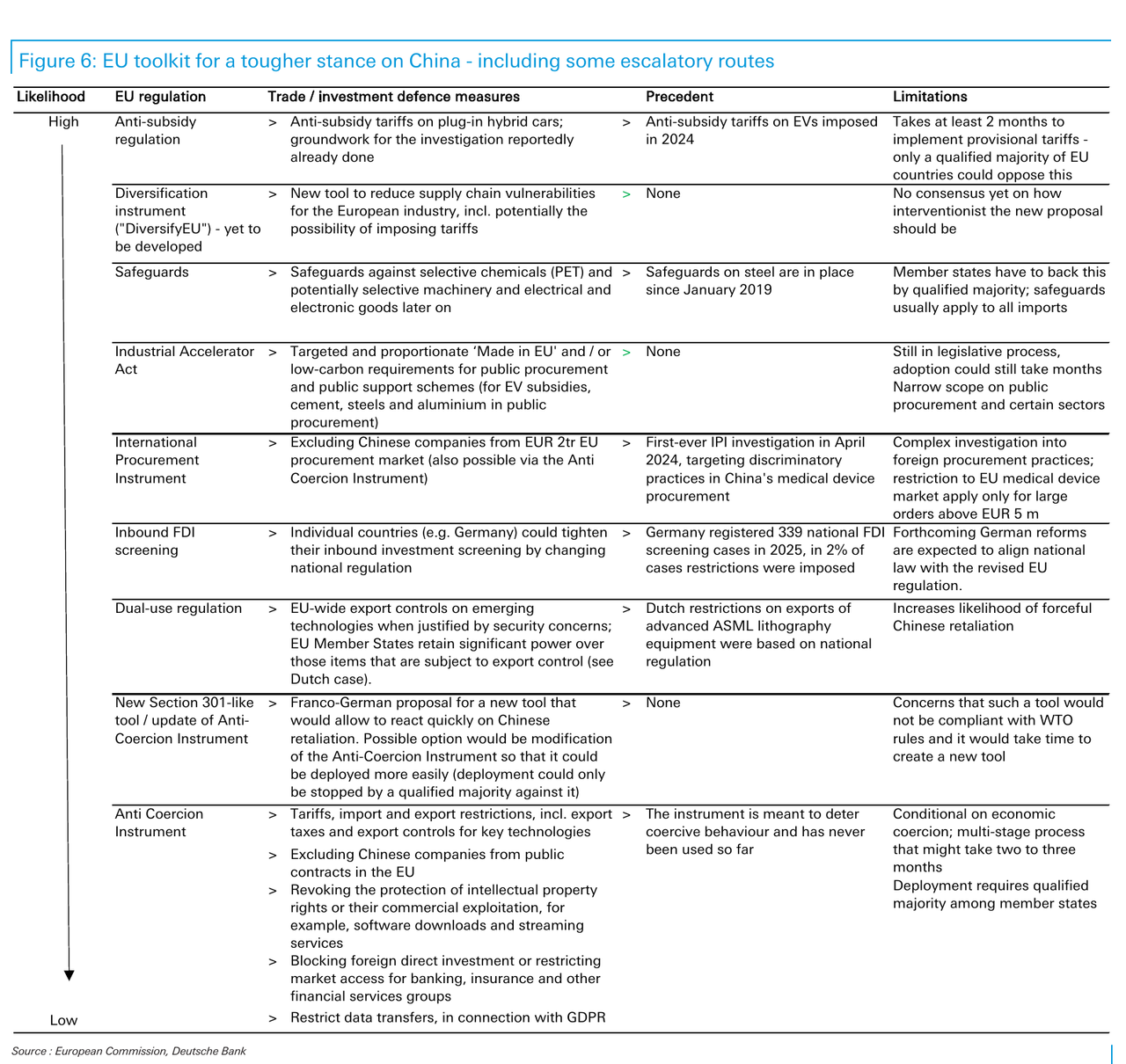
Image via ZeroHedge
Europe signals broader curbs on Chinese imports as politics catches up to industrial reality
The European Union is weighing wider restrictions on Chinese imports, marking a sharper turn in its trade posture toward Beijing. The thrust is political as much as economic: European leaders face growing pressure to respond to factory closures, supply-chain dependencies, and voter frustration over deindustrialization.
Supporters of tougher measures argue that China’s state-backed production capacity can overwhelm European producers and hollow out strategic sectors, from clean tech to advanced manufacturing. Critics warn that escalation could raise consumer prices, invite retaliation, and complicate Europe’s already difficult growth outlook, especially if restrictions are broad rather than targeted.
The most consequential question is implementation: whether Europe focuses on narrow, evidence-based trade defenses or reaches for sweeping curbs that function as industrial policy by another name. Either way, companies should prepare for more compliance friction and for trade policy to play a larger role in investment decisions.
✓ The Bottom Line: Europe is late, not reckless, in confronting a real problem: dependency plus subsidized overcapacity is a bad combination for any industrial base. But the EU should prioritize targeted enforcement tied to clear rules and measurable harm, because blanket curbs risk becoming expensive symbolism that damages European competitiveness. The smart move is pairing selective trade defenses with faster permitting, cheaper energy, and innovation policies at home, otherwise Europe will fight external competition while ignoring internal bottlenecks.
That’s the file for today. We’ll keep tracking what’s real, what’s noise, and what actually changes incentives.
— Brief Updates Editorial