Today’s Sponsor
While other sectors stall, AI investment is accelerating — showing up in earnings calls, corporate budgets, and real-world deployment. Capital is quietly concentrating around companies with clear demand and long-term relevance, and selective opportunities are forming right now.
A new research brief identifies 2 AI stocks trading under $15 that may be positioned for the next phase of growth — including key developments that could move these names in the months ahead.
Get the Free AI Stocks ReportBy following the link above, you're choosing to opt in to receive insightful updates from Investing Ideas Daily + 2 free bonus subscriptions! Your privacy is important to us. You can unsubscribe anytime. See our privacy policy for details.

A fair, well-rounded look at today’s news: Leon Black faces Congress over Epstein-related payments; JD Vance taps Silicon Valley donors; Trump’s first trip on a Qatari-gifted Air Force One; Venezuela’s quake search turns grim; and Hezbollah hardens terms as U.S.-backed talks drag on.
Image via AP News
Leon Black to face House investigators over $158M in payments tied to Epstein
Billionaire investor Leon Black is set to testify before Congress as House investigators revisit the financial relationship between Black and Jeffrey Epstein, focusing on roughly $158 million in payments Black made to Epstein over several years. The deposition is expected to examine what services Epstein claimed to provide, what Black understood about Epstein’s legal and reputational risks, and whether any institutions failed to flag or constrain the arrangement.
Black has previously said the payments were for tax, estate, and philanthropic planning advice, and that he was unaware of Epstein’s ongoing criminal conduct at the time. Congressional interest, however, is less about tabloid intrigue than about how elite financial networks can normalize high-risk actors—and whether disclosure, compliance, and governance systems at major firms were strong enough to prevent reputational and legal exposure.
Even absent new criminal allegations, the political stakes are real: the Epstein saga remains a proxy fight over elite accountability, the credibility of “due diligence” culture, and whether wealthy gatekeepers receive softer treatment than ordinary defendants. Lawmakers are likely to press for documents, timelines, and corroboration that can withstand courtroom-level scrutiny, not just public-relations narratives.
Read the full story at AP News →
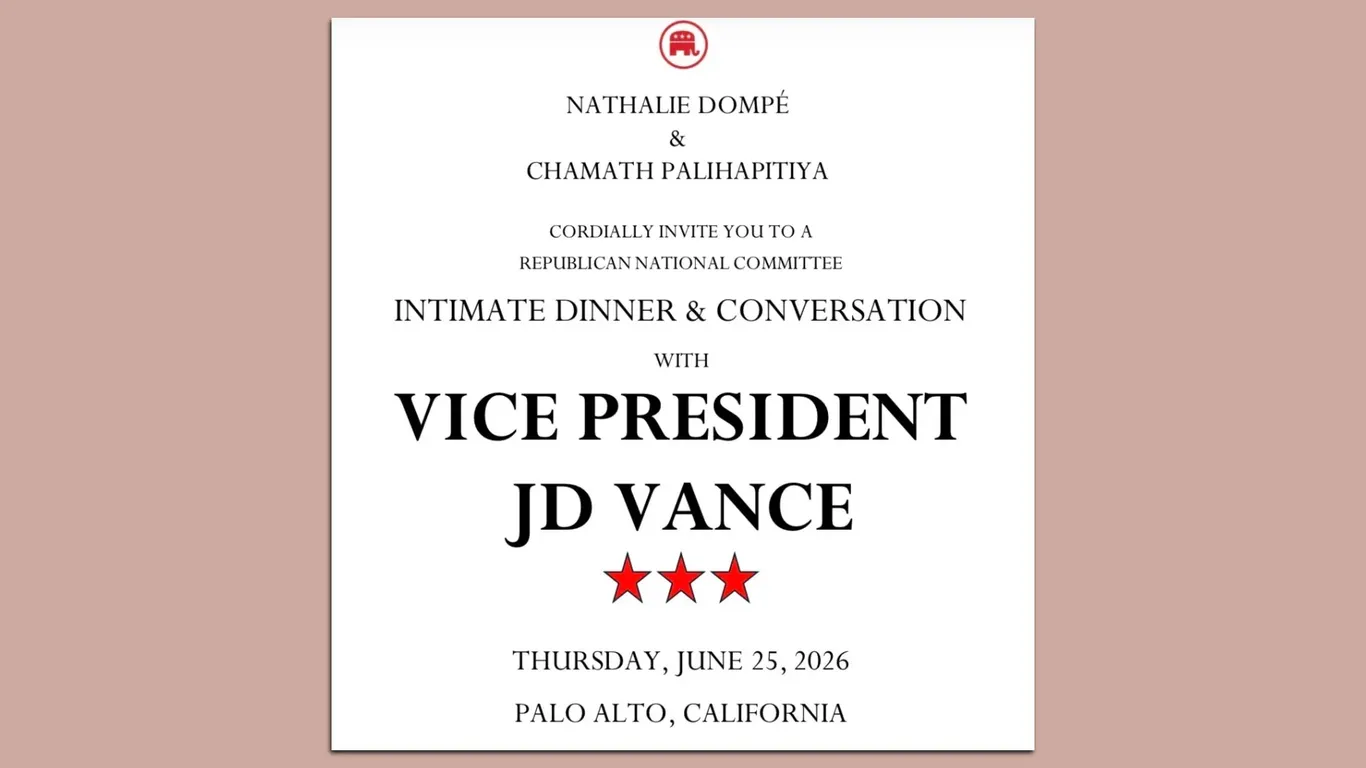
Image via Axios
JD Vance pulls $4.2M in Palo Alto, signaling GOP’s continued push into tech money
Vice President JD Vance headlined a Republican fundraiser in Palo Alto that brought in $4.2 million, a notable haul in a region long associated with Democratic fundraising dominance. The event, hosted at the home of investor and prominent podcast personality Chamath Palihapitiya, underscores how parts of Silicon Valley’s donor class are increasingly open to center-right economic messaging—especially around regulation, taxation, and geopolitical competition with China.
The significance is less about one check-writing night and more about coalition-building. Republicans have been trying to turn skepticism of progressive cultural politics and frustration with regulatory uncertainty into durable donor support. Democrats, for their part, still have deep institutional ties to tech, but the relationship has been strained by fights over antitrust, content moderation, labor classification, and AI oversight.
Fundraising in the Valley also comes with tradeoffs: candidates benefit from money and networks, but risk being tagged as aligned with wealthy insiders at a moment when voters across the spectrum are sensitive to economic inequality and perceived favoritism. Expect both parties to use Silicon Valley donations as a political weapon—either as proof of modernity and innovation, or as evidence of elite capture.
Read the full story at Axios →

Image via The Hill
Trump’s North Dakota trip to debut Qatari-gifted Air Force One—ethics questions follow
President Trump’s upcoming trip to North Dakota will be the first flight on a new Air Force One aircraft that the White House says was gifted by Qatar. The rollout is designed to project readiness and renewed presidential mobility, but it immediately raises questions about optics, national security vetting, and the precedent of accepting high-value foreign gifts tied to a marquee symbol of American power.
Supporters argue the practical case is straightforward: presidential airlift is expensive, replacement timelines are long, and a ready aircraft—if fully inspected, modified, and secured to U.S. standards—could reduce operational strain. Critics counter that “free” rarely means uncomplicated in geopolitics, and that even the perception of foreign influence can carry a cost, particularly in the Gulf where defense, energy, and diplomacy are tightly intertwined.
The key issues now are process and transparency: how the gift was structured legally, what security hardening was performed, and what safeguards prevent any intelligence or maintenance vulnerabilities. In Washington, the fight will be as much about trust as technology—whether the administration can demonstrate that national interest, not political theater or diplomatic favor-trading, drove the decision.
Read the full story at The Hill →
Venezuela earthquake toll rises as rescuers race dwindling odds
Venezuela’s death toll is rising after dual earthquakes struck parts of the country Wednesday, with rescuers combing unstable rubble and damaged buildings in a rapidly narrowing window for finding survivors. Search-and-rescue teams are working amid aftershocks and compromised infrastructure, conditions that slow heavy equipment and make even basic logistics—power, communications, medical transport—harder by the hour.
Natural disasters in Venezuela land on an already-stressed system. Years of economic turmoil and emigration have strained hospitals, emergency response capacity, and public services, while reliable information can be uneven as local authorities and national agencies try to assess damage across a wide area. International aid and neighboring support can help, but coordination and access are often the limiting factors in the first critical days.
As the response shifts from rescue to recovery, the next test will be whether the government can deliver temporary housing, rebuild essential services, and maintain public order without politicizing relief. For families, the immediate reality is more basic and brutal: waiting for word, searching shelters, and hoping a collapsed structure still holds an air pocket.
Read the full story at CBS News →
Hezbollah demands unconditional Israeli withdrawal as U.S. mediation drags on
Hezbollah is insisting Israel leave Lebanese territory “unconditionally” as U.S.-backed talks extend, hardening its public stance against what it frames as normalization or concessions. The group’s position raises the bar for any near-term diplomatic breakthrough, especially if Israel seeks guarantees on border security, rocket fire, or verification mechanisms before pulling forces back.
For Washington, the challenge is familiar: de-escalation requires sequencing—who moves first, under what monitoring, and with what enforcement if violations occur. Hezbollah’s demand aims to deny Israel political “wins,” but it also narrows the negotiating space for Lebanon’s state institutions, which have to balance sovereignty claims, domestic legitimacy, and the practical need to avoid renewed conflict.
The strategic context is bigger than a border line. Any deal will be shaped by Iran’s regional posture, Israel’s tolerance for risk near its northern communities, and Lebanon’s fragile internal politics. When maximalist statements dominate, talks can still produce technical arrangements—but only if both sides see the alternative as worse than an imperfect compromise.
Read the full story at Al Jazeera →
That’s the file for today. We’ll be watching for what Congress actually documents in the Black deposition, whether the Air Force One gift comes with enforceable safeguards, and how far diplomacy can go when the parties start from non-negotiable public demands.
— Brief Updates Editorial