Today’s Sponsor
America's national debt has blown past $40 trillion — and we're adding another trillion every five months. Interest payments alone now top $1 trillion a year, meaning borrowed money is paying interest on borrowed money. Economists call this a debt death spiral, and your retirement savings could be caught in the middle.
A new free report reveals the three ways governments escape a debt spiral, how purchasing power quietly erodes, and exactly how to move a portion of your savings into a financial safe haven before it's too late. No cost. No obligation. Delivered to your inbox in minutes.
Get the Free Debt Death Spiral ReportThis is an advertisement from American Alternative Assets. If you no longer wish to receive these promotions, unsubscribe here. American Alternative Assets | 21700 W Oxnard St, Suite 850, Woodland Hills, CA 91367.

A fair, well-rounded look at today’s news: a stronger October jobs print after the midterms, a gold rally that’s holding up, Bahrain’s internal fault lines under Iran-war pressure, a butane supply shock hitting consumers and industry, and Taiwan warning of online interference ahead of local votes.

Image via ABC News
October jobs report shows hiring accelerated after the midterms
The October jobs report showed hiring accelerated, delivering the first major read on the economy since the midterm elections and giving markets a fresh data point on whether the labor market is cooling or re-heating. A faster pace of job gains typically signals ongoing demand for workers, but it also keeps the Federal Reserve’s inflation fight front and center if wage pressures follow.
Investors and policymakers will parse the details beyond headline payroll growth, including labor force participation, average hourly earnings, hours worked, and revisions to prior months. For households, the report’s practical meaning is whether paychecks are rising faster than prices and whether job availability remains broad-based rather than concentrated in a narrow set of sectors.
The political backdrop matters too: stronger employment can bolster consumer spending and tax receipts, but it can also complicate efforts to bring inflation down if the economy runs hot. The next few weeks of inflation data, along with any Fed guidance, will determine whether this report is treated as a welcome sign of resilience or a warning that policy needs to stay tighter for longer.
✓ The Bottom Line: A faster hiring pace is good news for workers and a reminder that recession calls can be overstated when the labor market is still creating jobs. But if wage growth is firm and participation isn’t rising, the Fed will have a harder time declaring victory on inflation. The responsible read is optimism with discipline: celebrate job creation, but don’t assume rate cuts are around the corner.
📎 ABC News
Gold dips on the day, but still heads for its best week in over two months
Gold prices slipped, but the metal remained on track for its strongest weekly performance in more than two months, reflecting a market that is still paying for protection. Even when gold fades in a single session, a strong week often signals that investors are rebalancing toward safe-haven assets amid uncertainty over rates, growth, or geopolitics.
The immediate driver is usually a mix of the U.S. dollar’s moves and Treasury yields: firmer yields can pressure gold because it offers no income, while a softer dollar tends to support it. But weekly strength suggests more than day-to-day trading noise, pointing to persistent demand from funds, central banks, or retail buyers looking to hedge inflation risk and geopolitical shocks.
For consumers, gold’s direction can foreshadow broader sentiment: when fear trades win, risk appetite can narrow. For policymakers, it’s another signal that markets are still not fully comfortable with the inflation outlook or global stability, even if inflation readings improve at the margins.
✓ The Bottom Line: Gold’s weekly pop looks less like a fad and more like a vote for uncertainty hedging, especially with global tensions and rate expectations still unsettled. The key is to watch whether real yields keep drifting up; if they do, gold rallies may struggle to sustain. As a portfolio signal, this reads as caution, not panic.
📎 Reuters

Image via South China Morning Post
Bahrain tightens internal security as Iran war stokes sectarian fault lines
Bahrain is facing renewed internal strain as the Iran war revives long-simmering tensions between the ruling establishment and the country’s Shiite Muslim majority. Authorities, shaken by the precision of Iranian attacks on Bahrain and by reported support for those strikes among some Bahrainis, have moved to intensify security measures and crack down on dissent.
The stakes in Bahrain are unusually high because the island’s domestic politics and regional alignment are inseparable. Bahrain hosts key Western military assets and sits at the center of Gulf security architecture; any sign of destabilization reverberates across energy markets, shipping lanes, and alliance planning. At the same time, longstanding grievances among parts of the Shiite population create openings for Iranian influence, whether direct or indirect.
A tougher security posture may reduce near-term risk of unrest, but it also risks deepening alienation if it is perceived as collective punishment rather than targeted law enforcement. The broader conflict environment makes compromise harder: in wartime, governments prioritize control, while opposition movements may interpret crackdowns as proof that political avenues are closed.
✓ The Bottom Line: Bahrain has a legitimate security problem when a regional adversary can strike its territory and exploit internal divisions, but repression is a blunt tool that can backfire. The smart approach is narrowly targeted counter-espionage and public-order enforcement paired with credible political and economic inclusion that undercuts Tehran’s narrative. If the state treats a whole community as suspect, it risks turning a security challenge into a chronic legitimacy crisis.
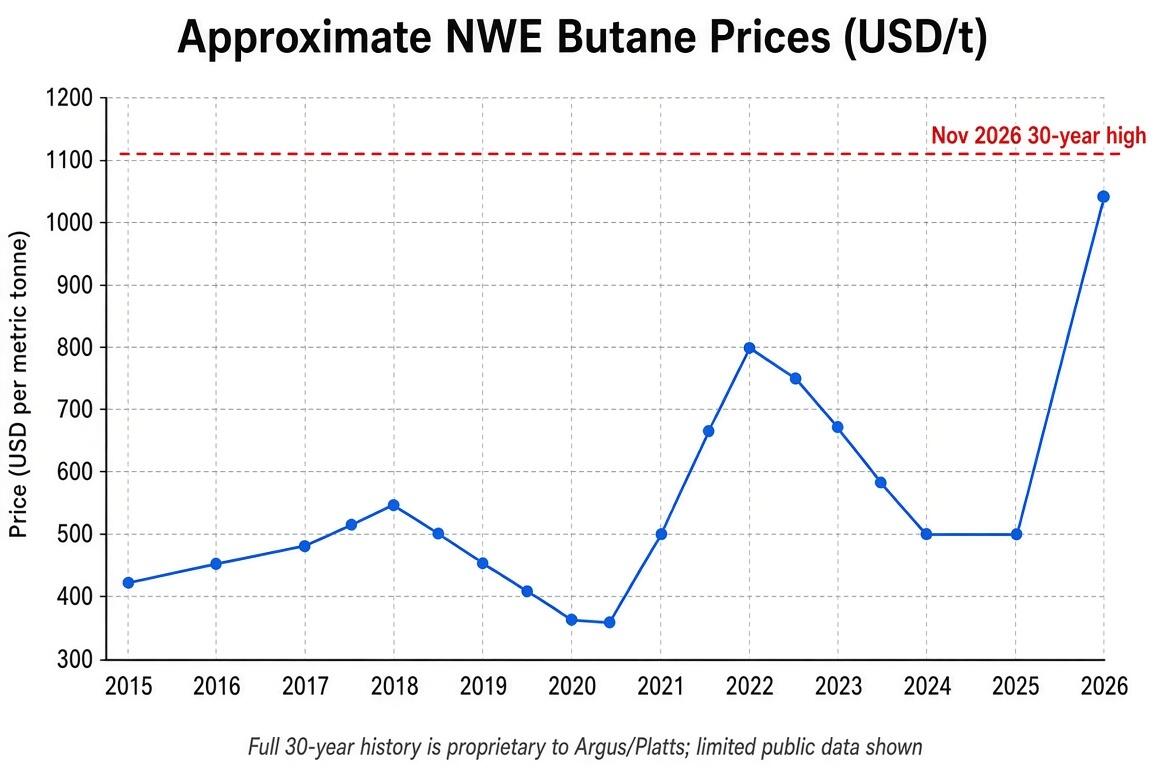
Image via ZeroHedge
Butane hits decade highs as supply constraints collide with winter demand
Butane prices are surging to decade highs as multiple pressures hit at once: tight supply, seasonal demand, and logistical constraints that amplify small disruptions into bigger price moves. Butane is not just a niche fuel; it is a key component for heating, blending, and petrochemical feedstocks, meaning spikes can filter into consumer energy costs and industrial input prices.
The “perfect storm” dynamic typically reflects constrained export flows, refinery and processing limitations, and regional imbalances that force buyers to compete for marginal barrels. In colder months, heating demand and storage needs rise, while petrochemical demand can remain firm, leaving less slack in the system. When inventories are low, price volatility becomes the market’s way of rationing supply.
For businesses, elevated butane costs can squeeze margins, particularly in chemicals and downstream fuel blending, and can also raise transport and storage expenses. For policymakers, this is another reminder that energy affordability is not only about crude oil; the broader liquids and gas complex can deliver inflation surprises even when headline oil prices look stable.
✓ The Bottom Line: This butane spike is a classic lesson in how “secondary” energy markets can still hit household budgets and industrial competitiveness. Regulators should resist the temptation to paper over shortages with price controls; the better fix is transparency, infrastructure resilience, and permitting that expands flexible supply and storage. In the meantime, companies exposed to butane should treat volatility as a risk-management priority, not an accounting footnote.

Image via NTD
Taiwan warns of online election interference ahead of local votes
Taiwan’s President Lai Ching-te warned of online interference ahead of upcoming local elections, highlighting concerns that external actors could use disinformation, fake accounts, and influence operations to shape turnout and public opinion. The warning comes as Taiwan’s politics remain a focal point of cross-strait tensions and as democracies worldwide grapple with the speed and scale of digital manipulation.
Taipei’s concern is not abstract: election meddling efforts can blend cyber tactics with information warfare, laundering narratives through local channels to make them appear organic. The goal is often less about persuading voters of a single claim and more about eroding trust, deepening polarization, and creating a sense that democratic outcomes are illegitimate or chaotic.
The policy challenge is balancing vigilance with civil liberties. Overbroad countermeasures can chill speech and hand critics an easy talking point, while underreaction invites a permissive environment for hostile operations. Effective defenses tend to rely on rapid attribution, platform cooperation, public transparency, and civic resilience rather than sweeping censorship.
✓ The Bottom Line: Taiwan is right to treat online interference as a national security issue, but the credibility of the response will hinge on precision and transparency. The strongest antidote is sunlight: clear evidence, timely public briefings, and narrow actions against coordinated inauthentic behavior, not broad policing of political debate. Democracies win these fights by staying democratic, even under pressure.
📎 NTD
That’s the file for Friday. We’ll be watching how markets digest the jobs data into rate expectations, and whether regional tensions and energy bottlenecks keep pushing risk premiums higher.
— Brief Updates Editorial