Today’s Sponsor
History shows a clear pattern: the investors who recognized the exact inflection point in the dot-com boom pocketed 400–800% gains in 18 months. Those who spotted the same moment in cloud computing saw 300–600% returns. Based on 50 years of market data, that same moment is happening right now — and the acceleration phase has already begun.
This free 7-page report reveals where we are in the current megatrend cycle, why the next 18 months are critical, and how to position yourself before the window closes. Don't be the investor who enters too late.
Get the Free ReportBy clicking 'Get the Free Report' you are automatically subscribing to Darwin Investor Network and will receive a free subscription to the Chaikin PowerFeed newsletter. Unsubscribing is easy. Privacy Policy

Five stories shaping the day: a Senate campaign-finance probe, a major Supreme Court privacy ruling, South Africa braces for anti-immigration marches, an Apple supply-chain breach, and Nvidia’s China robotics push.
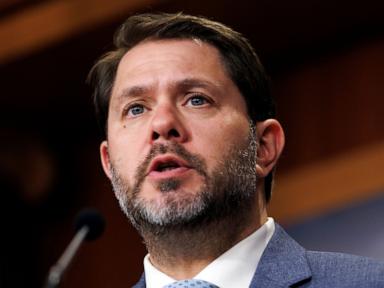
Image via ABC News
Sen. Ruben Gallego faces campaign-finance scrutiny over family travel spending
Sen. Ruben Gallego is under investigation for suspected campaign-finance violations tied to alleged use of campaign funds for family travel, including trips to the Caribbean, Miami, Nantucket, and Puerto Rico. The matter centers on whether expenses billed to campaign accounts were legitimately connected to campaign activity or crossed into personal use—an area where federal rules are strict, but enforcement often hinges on documentation and intent.
Campaign committees can pay for certain travel when it is directly related to campaign events or fundraising, but they generally cannot cover expenses that would exist “irrespective” of the campaign—such as vacations or purely personal travel. These cases often turn on calendars, itineraries, receipts, and whether campaign events actually occurred where and when the travel was booked.
The broader political stakes are straightforward: ethics and campaign-finance inquiries can drain time, money, and attention, and they tend to linger even when the ultimate outcome is a settlement or a finding short of criminal wrongdoing. For voters, the key questions are factual—what the trips were for, who traveled, who paid, and what paperwork supports the campaign’s explanation.
Source: ABC News
Read the full story at ABC News →
Supreme Court says constitutional protections extend to location data
The Supreme Court ruled that constitutional protections apply to location data, reinforcing limits on government access to highly revealing digital records. Location histories—whether drawn from phones, apps, carriers, or other intermediaries—can map a person’s movements with precision, effectively producing a real-time portrait of private life.
The decision lands amid an ongoing policy fight: law enforcement agencies argue that fast access to location data can be essential in kidnappings, violent crimes, and urgent threats, while civil-liberties advocates warn that easy access invites broad surveillance and fishing expeditions. The Court’s approach signals that, as technology evolves, constitutional safeguards do not evaporate simply because data sits with a third party or is generated passively.
Practically, the ruling is likely to push agencies toward warrants more often and to shape how lower courts treat “geofence” and other mass location requests. It also increases compliance pressure on tech and telecom companies, which now face clearer constitutional boundaries when responding to government demands for sensitive location information.
Source: PBS
Image via The Guardian
South Africa deploys police ahead of anti-immigration marches as officials fear repeat of 2008 violence
South African authorities have deployed police units across multiple areas ahead of planned anti-immigration marches, amid government concern that demonstrations could escalate into attacks on migrants and foreign-owned businesses. The memory driving the security posture is 2008, when widespread xenophobic violence included looting and left dozens dead.
Supporters of the marches argue the protests reflect real economic pressures—high unemployment, strained public services, and anger over crime—and that government has failed to enforce borders and labor rules. Critics counter that migrants are being scapegoated for complex problems and warn that public rhetoric can quickly translate into targeted violence against communities that have limited protection.
The state’s challenge is to protect lawful protest while preventing intimidation, mob action, and collective punishment. That means visible policing, clear red lines for violence and incitement, and—if officials want more than a temporary calm—credible steps to address both immigration administration and the deeper economic frustrations that fuel political opportunism.
Source: The Guardian
Read the full story at The Guardian →
Apple iPhone 18 Pro leak follows Tata Electronics hack, spotlighting supply-chain security
Documents and photos tied to Apple’s iPhone 18 Pro reportedly leaked after a hack involving Tata Electronics, one of Apple’s suppliers in India. The incident underscores a basic reality of modern hardware: even companies with tight internal controls can be exposed through vendors that handle components, manufacturing, logistics, or testing.
What’s known so far points to stolen materials that could reveal design details, part numbers, internal processes, or prototype imagery—information that can aid counterfeiters, give competitors clues about features and timelines, or simply spoil Apple’s carefully staged product narrative. For consumers, leaks rarely change what ships; for Apple, the bigger concern is intellectual property, supplier discipline, and whether the breach exposes any personally identifiable data (none has been the central claim in early reporting).
The strategic context matters, too: Apple has been expanding and deepening production capacity in India as it diversifies beyond China, and that scale-up increases the number of touchpoints where security has to be consistently enforced. Expect Apple to tighten supplier audit requirements, restrict internal access, and pursue legal remedies—while suppliers face intense pressure to demonstrate that their cybersecurity and physical security controls can match Apple’s expectations.
Source: Al Jazeera
Read the full story at Al Jazeera →

Image via South China Morning Post
Nvidia expands China robotics hiring as “physical AI” becomes the next battleground
Nvidia is boosting its robotics team in China as the industry pivots toward what many firms are calling “physical AI”—systems that connect advanced models to real-world machines like robots, autonomous devices, and factory automation. China’s importance is structural: its robotics vendors account for a large share of global shipments, and the country is a crucial market for industrial automation and hardware-centric AI development.
For Nvidia, the move is about positioning as AI shifts from screens and servers into manufacturing floors and logistics networks, where compute, sensors, simulation, and edge deployment matter as much as data-center training. The company’s software stack and chips are widely used in AI development, and robotics is a natural adjacency—though it is also a domain where local ecosystems, integration partners, and regulatory constraints can define what is commercially possible.
This expansion comes against a complicated geopolitical backdrop. U.S.-China tech tensions and export controls continue to shape what advanced hardware and tooling can be sold, where research can be performed, and how multinationals structure teams. The takeaway: robotics is becoming a major front in AI competition, and Nvidia is trying to ensure it remains a default platform—even in markets where policy risk and domestic alternatives are both rising.
Source: South China Morning Post
Read the full story at South China Morning Post →
That’s the file for today. We’ll be watching for the next filings in the Gallego probe, how quickly agencies adapt to the Court’s location-data ruling, and whether today’s street politics in South Africa stay contained.
— Brief Updates Editorial