Today’s Sponsor
One warehouse robotics company is sitting on a $22.7 billion order backlog — contracts signed, revenue incoming — and its stock is down 16.6% in the past month. That disconnect is exactly the kind of setup worth paying attention to. Heading into 2026, analysts screened the entire robotics sector and found 7 stocks with compelling cases: a pure-play warehouse name with $2B cash and zero debt, a semiconductor robotics firm that nearly doubled quarterly revenue year-over-year, and a robotic surgery company placing hundreds of next-gen systems while trading 31% below its 52-week high.
Every name and the full case behind it is available in a free report — no forms, no friction. Backlogs that size take time to convert, which means the window to understand these setups is open right now. Don't wait.
Get Your Free Robotics ReportBy clicking this link you agree to receive emails from TradingTips and our affiliates. You can opt out at any time. — Privacy Policy

Tuesday, September 22, 2026: A Wall Street call on battered aerospace shares, a warning about the costs of the AI sprint, mixed signals on Hormuz, fresh U.S. reassurance in Asia ahead of Trump-Xi, and how data centers are reshaping LNG demand in Southeast Asia.

Image via Yahoo Finance
BofA sees value in a beaten-down aviation giant as investors debate whether the slide is overdone
Bank of America is urging clients to buy shares of a major aviation company after a steep selloff, arguing the market is discounting a worst-case outcome that may not materialize. The call comes as the stock has been pressured by a mix of program execution worries, delivery and certification uncertainty, and the broader market’s sensitivity to industrial names exposed to rates and global growth.
BofA’s thesis, as reported, rests on the idea that fundamentals and long-cycle demand for commercial aircraft can reassert themselves once near-term headlines cool. The bullish view is not a denial of risk; it is a bet that the company’s order book, services revenue, and the strategic importance of a healthy global duopoly justify paying up for time and volatility.
Investors should still separate “cheap” from “investable.” In aerospace, sentiment can stay negative longer than models expect, especially if regulators, suppliers, and customers are simultaneously tightening the screws. The next few quarters will likely hinge less on analyst targets and more on tangible markers: production stability, delivery cadence, and credible guidance that stops moving the goalposts.
✓ The Bottom Line: Buying into a plunge can be smart, but only if you can articulate what changes next and when. In this case, the bull case is plausible, yet the company has to earn back trust with operational proof, not just valuation arguments. If you own it, demand measurable milestones; if you’re considering it, size the position like it could stay painful.

Image via Fortune
Fortune argues the AI race is drifting from innovation toward exhaustion
A Fortune commentary warns that the global push for AI “supremacy” is increasingly defined by brute-force scaling, higher energy draw, and a talent and capital arms race that may not be sustainable. The piece frames the next phase of AI not as a contest for dominance, but as an engineering and governance challenge: building systems that are efficient, resilient, and worthy of trust.
The argument lands at an awkward moment for the industry. Companies are racing to secure GPUs, power contracts, and proprietary data advantages while regulators on both sides of the Atlantic try to write rules that won’t be obsolete on arrival. At the same time, consumers and enterprises want tangible productivity gains, not just bigger models and flashier demos.
Fortune’s broader “watercooler” tone underscores a real shift in boardrooms: the conversation is moving from experimentation to operating costs, reliability, and liability. As AI deployments become infrastructure, the winners won’t just be the labs with the biggest clusters; they’ll be the firms that can deliver consistent performance per dollar and per watt, with governance that survives scrutiny.
✓ The Bottom Line: The evidence increasingly suggests the limiting factor for AI is not ideas but inputs: electricity, chips, cooling, and competent deployment. “Supremacy” rhetoric makes for great fundraising, but sustainability is what turns a technology wave into durable economic output. The companies that treat efficiency and safety as core product features, not PR, are the ones most likely to compound value.
📎 Fortune
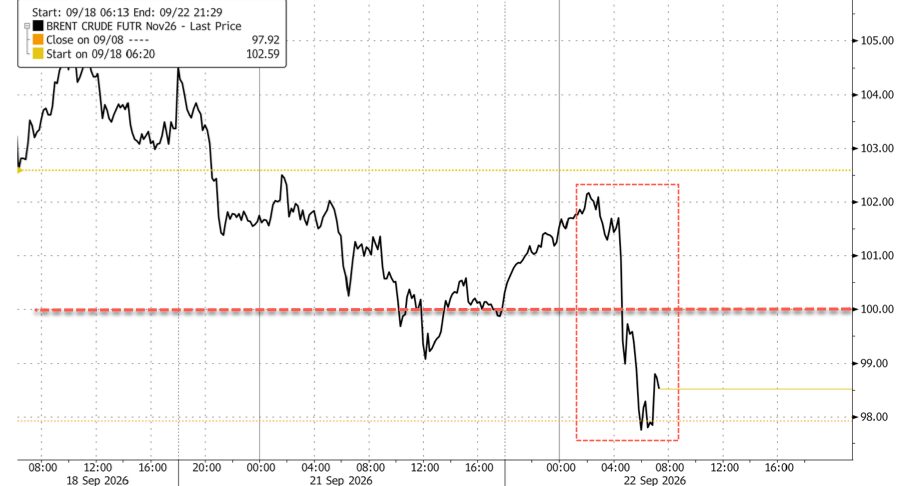
Image via ZeroHedge
Hormuz headlines whipsaw oil as Iranian media disputes reopening report
Oil prices swung after a report suggesting Iran might be willing to reopen or ease constraints around the Strait of Hormuz, a critical chokepoint for global energy shipments. According to coverage highlighting market reaction, Brent slid amid the implication that maritime risk premiums could fade if the passageway’s status becomes less contested.
Iran’s Fars News Agency then labeled the Reuters-related claim “invalid,” injecting fresh uncertainty and signaling that any near-term “de-escalation” narrative is far from confirmed. The dispute landed just ahead of a major political moment, with President Trump expected to address the United Nations, raising the stakes for messaging and market interpretation.
The practical issue for traders and policymakers is that Hormuz risk is not binary. Even absent formal closure, elevated tensions can raise insurance costs, disrupt routing, and force strategic stockpiling. A single contradictory headline can move prices, but durable shifts require verifiable changes in naval posture, shipping guidance, and diplomatic commitments.
✓ The Bottom Line: Markets should treat anonymous or politically convenient “reopening” signals with skepticism until there is observable change on the water. The Strait of Hormuz is too central to global supply for prices to rely on narrative alone. If anything, the whiplash reinforces that energy security premiums are likely to remain sticky in a world where politics can reverse in a day.
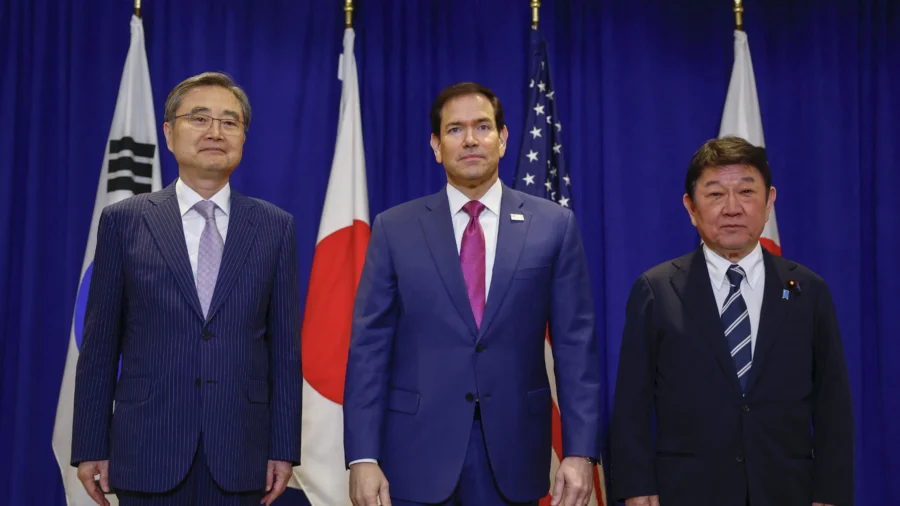
Image via NTD
U.S. reaffirms support for Japan, South Korea, and Taiwan ahead of Trump-Xi talks
The U.S. is emphasizing security backing for key Indo-Pacific partners as President Trump prepares for talks with China’s President Xi, according to NTD. The report describes high-level engagement involving Secretary of State Marco Rubio and counterparts from Japan and South Korea, underscoring alliance coordination as the region watches for any signals of U.S.-China dealmaking.
The timing matters because summit optics can spook allies if they fear their interests will be traded for short-term diplomatic wins. Reassurances to Tokyo and Seoul typically center on extended deterrence, interoperability, and a shared approach to regional stability, while Taiwan messaging tends to focus on maintaining peace and discouraging unilateral changes to the status quo.
The broader context is that deterrence relies on consistency. Allies want clarity on force posture, joint exercises, and contingency planning, not just statements. Meanwhile, Beijing will likely test whether U.S. commitments are rhetorical or backed by sustained capability and political will.
✓ The Bottom Line: Public reassurance is necessary, but it’s not sufficient; credibility comes from budgets, deployments, and repeatable coordination, especially with Taiwan. A Trump-Xi summit can be useful if it reduces miscalculation, but allies are right to worry about ambiguity. The U.S. should pair diplomacy with visible, boring, day-to-day alliance work that makes deterrence real.
📎 NTD

Image via Forbes
Southeast Asia’s data center surge is quietly becoming an LNG story
A growing wave of hyperscale data center construction in Southeast Asia is lifting demand for liquefied natural gas, as the region scrambles for reliable power to support AI and cloud workloads, Forbes reports. Where grid reliability is uneven and renewable build-outs face permitting and transmission bottlenecks, gas is often the fastest dispatchable option to keep servers running around the clock.
The dynamic is reshaping energy planning across countries competing to attract investment from major tech firms. New capacity means not just generation, but also fuel contracts, import terminals, and midstream infrastructure, with governments balancing price stability, energy security, and emissions targets.
The data center boom also creates second-order effects: higher baseline demand can tighten regional LNG markets during peak seasons, and it can complicate decarbonization promises if gas becomes the default bridge that never ends. The winners will be jurisdictions that can expand power supply while upgrading grids, permitting renewables faster, and designing pricing that doesn’t dump the cost onto households.
✓ The Bottom Line: This is a reminder that the AI economy is physical: chips need electrons, and electrons need fuel and transmission. LNG can be a pragmatic near-term solution in parts of Southeast Asia, but the long-run test is whether governments use gas as a bridge to cleaner, more resilient grids or as an excuse to delay hard reforms. The smartest strategy is reliability now paired with an aggressive build-out of transmission, storage, and firm low-carbon power.
📎 Forbes
That’s the day’s read: big claims, bigger constraints, and markets reacting in real time. We’ll be watching for hard evidence behind the headlines.
— Brief Updates Editorial