Today’s Sponsor
Forget trendy tech — the biggest income opportunities right now are hiding in plain sight. Our newest research has uncovered three high-yield dividend powerhouses generating billions in free cash flow: an energy infrastructure leader paying a 7.3% yield, a tobacco giant delivering an 8.6% dividend, and a consumer-finance specialist posting a massive 9.2% yield — all with conservative payout ratios built to last.
These cash machines are built to thrive even when markets turn choppy — and smart income investors are positioning right now, before this report goes public. Don't miss your window.
Download Your Free Report NowBy clicking the link above you agree to receive emails from StockEarnings and our affiliates. You can opt out at any time. Privacy Policy.

Tuesday, October 6, 2026: Wall Street profit projections hit new highs, Paramount closes its blockbuster WBD acquisition, Ted Cruz steps into Ken Paxton’s orbit, Trump’s Iran comments spark backlash, and SpaceX reframes itself as an AI-first play.
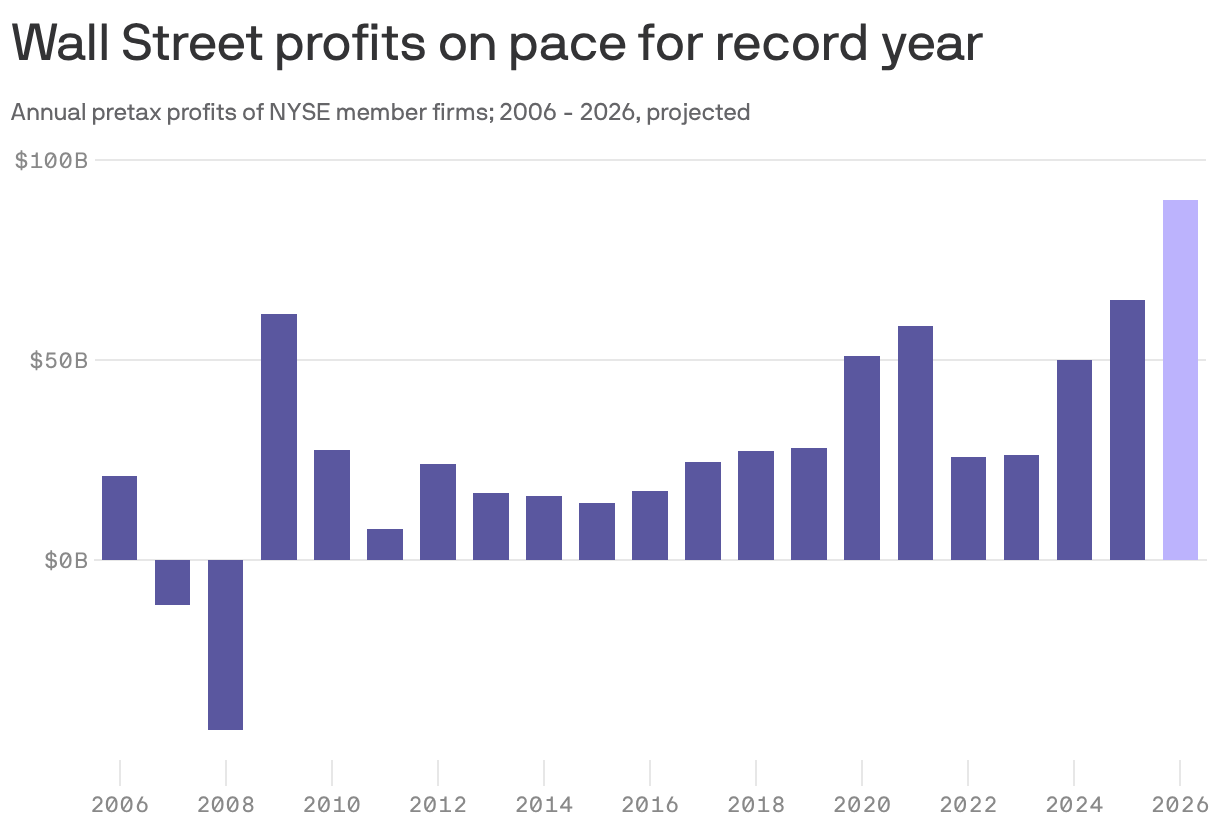
Image via Axios
Wall Street is pacing toward record profits, led by a strong first half
Wall Street’s biggest firms are on track for record-setting profits this year if the pace from the first half holds, according to data cited by the New York State Comptroller and highlighted by Axios. The story is a familiar one: strong market activity, resilient consumer balance sheets, and steady dealmaking have helped keep fee and trading revenue elevated, even with rates and economic uncertainty still in the mix.
Politically, a record year for bank profits lands in a touchy moment. Supporters argue high earnings reflect a functioning capital market that funds growth, retirement accounts, and liquidity during volatile periods. Critics counter that concentrated financial power and fee-heavy business lines can widen inequality and leave households feeling squeezed, especially when credit card rates stay high and bank fees remain a point of public anger.
The key implication is that profitability is becoming less of a leading indicator for the broader economy than it once was. A hot year for Wall Street can coexist with uneven conditions on Main Street, especially when wealth effects and market participation are not broadly shared.
✓ The Bottom Line: Record bank profits aren’t automatically a scandal, but they are a flashing signal to regulators and lawmakers: the sector’s resilience is real, and so is its political vulnerability. If Washington wants to avoid performative crackdowns, it should focus on transparency, competition, and consumer-facing abuses rather than punishing profitability itself. The public will tolerate strong earnings more readily when the system is clearly fair, rules-based, and accountable.
📎 Axios

Image via The Hill
Paramount closes its Warner Bros. Discovery acquisition, reshaping the media power map
Paramount said it has officially closed its multi-billion-dollar acquisition of Warner Bros. Discovery, a deal that creates a new heavyweight across news, sports, and entertainment, according to The Hill. The combination brings major studio and TV assets under one roof and consolidates a long list of recognizable brands at a time when legacy media is still fighting for margin in a streaming-dominated marketplace.
Strategically, the pitch is scale: more content, more leverage with distributors and advertisers, and a bigger platform to spread the costs of production, sports rights, and technology. Skeptics, including some consumer and labor voices, warn that consolidation can mean layoffs, fewer creative bets, and less viewpoint diversity in news and culture, even if executives promise stability.
The near-term reality is integration risk. Merging leadership structures, streaming strategies, and overlapping back-office operations will test whether the new company can cut costs without hollowing out the very product it’s trying to sell: distinctive content that audiences actually choose to pay for.
✓ The Bottom Line: This deal is a bet that bigger is safer in an era when content costs rise faster than subscription growth. It may prove necessary, but it isn’t automatically healthy: fewer major competitors usually means less innovation and more pricing power. Regulators should stay focused on concrete harms like market foreclosure and local news erosion, not just the size of the headline.
📎 The Hill

Image via Politico
Ted Cruz becomes Ken Paxton’s inside track as Texas politics churns
Sen. Ted Cruz is boosting Texas Attorney General Ken Paxton with fundraising support and strategic advice as Paxton weighs his next move, Politico reports. The dynamic matters because Cruz brings national donor networks and a finely tuned sense of Republican primary politics, especially in a state where ideological signaling can matter as much as governing credentials.
For Paxton, the relationship helps in two ways: money and legitimacy with key factions of the GOP base. For Cruz, it’s also a hedge, keeping influence over a volatile state political ecosystem and strengthening ties to an ambitious figure who could be an ally or a rival depending on what offices open up.
The broader context is a Texas Republican Party still sorting out its internal hierarchy. Power is increasingly brokered through primary turnouts, activist networks, and donor infrastructures rather than traditional party establishment cues, which makes high-profile alliances like this more consequential than they might appear from the outside.
✓ The Bottom Line: Cruz’s involvement is a reminder that modern politics runs on infrastructure: fundraising, endorsements, and message discipline. The risk for Republicans is that internal alliances can reward combativeness over competence, especially when legal and ethical clouds follow the personalities involved. Voters should treat political star power as a data point, not a substitute for a record that withstands scrutiny.
📎 Politico
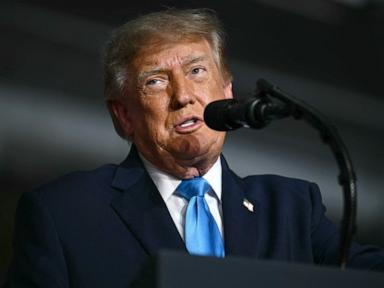
Image via ABC News
Trump warns Iran could hit Los Angeles and San Diego, drawing condemnation
President Donald Trump suggested at a Nebraska rally that Iran could “take out” Los Angeles and San Diego if it develops nuclear weapons, comments that drew swift condemnation, according to ABC News. The remarks come amid long-running fears about nuclear proliferation and the possibility that Iran could eventually field capabilities that threaten U.S. interests and allies.
Supporters often argue Trump’s style is blunt deterrence: talk tough, raise the stakes, and keep adversaries uncertain. Critics respond that this kind of rhetoric can inflame public fear, oversimplify the technical and strategic realities of nuclear deterrence, and complicate allied diplomacy by making U.S. messaging look impulsive.
Substantively, the core policy question remains unchanged: how to prevent Iran from achieving a nuclear weapon while maintaining credible military options and workable diplomatic channels. What changes is the temperature of the conversation, especially when leaders use specific American cities as rhetorical props.
✓ The Bottom Line: Iran’s nuclear ambitions are a serious national security issue, but naming U.S. cities in apocalyptic terms is more heat than light. Credible deterrence comes from capability, alliances, and clear red lines, not rally-stage hypotheticals that can spook the public and box in policymakers. The administration should be measured in public and relentless in private pressure.
📎 ABC News
SpaceX pops on an AI narrative shift, with investors pricing in ‘superintelligence’ upside
SpaceX shares jumped 7.6% as investors latched onto the company’s framing as a “super intelligence” player, Barron’s reports. The move signals that the market is increasingly valuing SpaceX not just as a launch-and-satellites story, but as a platform company where data, compute, and advanced autonomy could become central to the business model.
The bullish case is straightforward: Starlink’s network generates massive operational data, SpaceX builds and iterates hardware at speed, and the company sits at the intersection of communications, aerospace, and national security demand. The skeptical case is also straightforward: “superintelligence” can be an elastic label, and investors may be projecting software-style multiples onto a capital-intensive business with real-world constraints.
What’s not in dispute is the strategic direction of capital markets. If investors keep rewarding AI adjacency, companies with credible data pipelines and mission-critical infrastructure will try to reposition themselves accordingly, whether or not AI becomes a durable profit center on its own.
✓ The Bottom Line: SpaceX is already a remarkable engineering enterprise; it doesn’t need AI buzzwords to justify its importance. Investors should separate real AI-enabled advantage, like network optimization and autonomy, from branding that inflates expectations. The upside is plausible, but the discipline should be the same as always: show the product, show the margins, show the moat.
📎 Barron's
That’s the day’s big movement: money flowing to scale, politicians chasing leverage, and markets rewarding the next narrative. We’ll keep sorting signal from noise.
— Brief Updates Editorial