Today’s Sponsor
The Fed held rates, inflation is still above target, and uncertainty is rising — that means the "buy anything AI" trade is over. Smart money is rotating fast toward the companies actually building AI infrastructure: chips, cloud capacity, and mission-critical data tools. Big Tech alone is projected to spend $635B–$665B on AI in 2026 — and not all of it is going where most investors are looking.
We've identified 9 AI stocks worth watching right now — including a lesser-known chip name tied to U.S. AI infrastructure, a cloud player with improving setup, and a data analytics company with government exposure. This isn't hype. It's about following where capital is actually being deployed.
Get the Free Report NowBy clicking the link above, you will receive this free report and a free subscription to the StockEarnings daily email newsletter. You are also agreeing to the terms of our Privacy Policy. Unsubscribe at any time.

A fair, well-rounded look at today’s news, from the AI-driven split between Wall Street and Main Street to Gulf energy disruptions, Russia’s escalating strikes in Ukraine, and the tightening battle lines in key U.S. Senate contests.
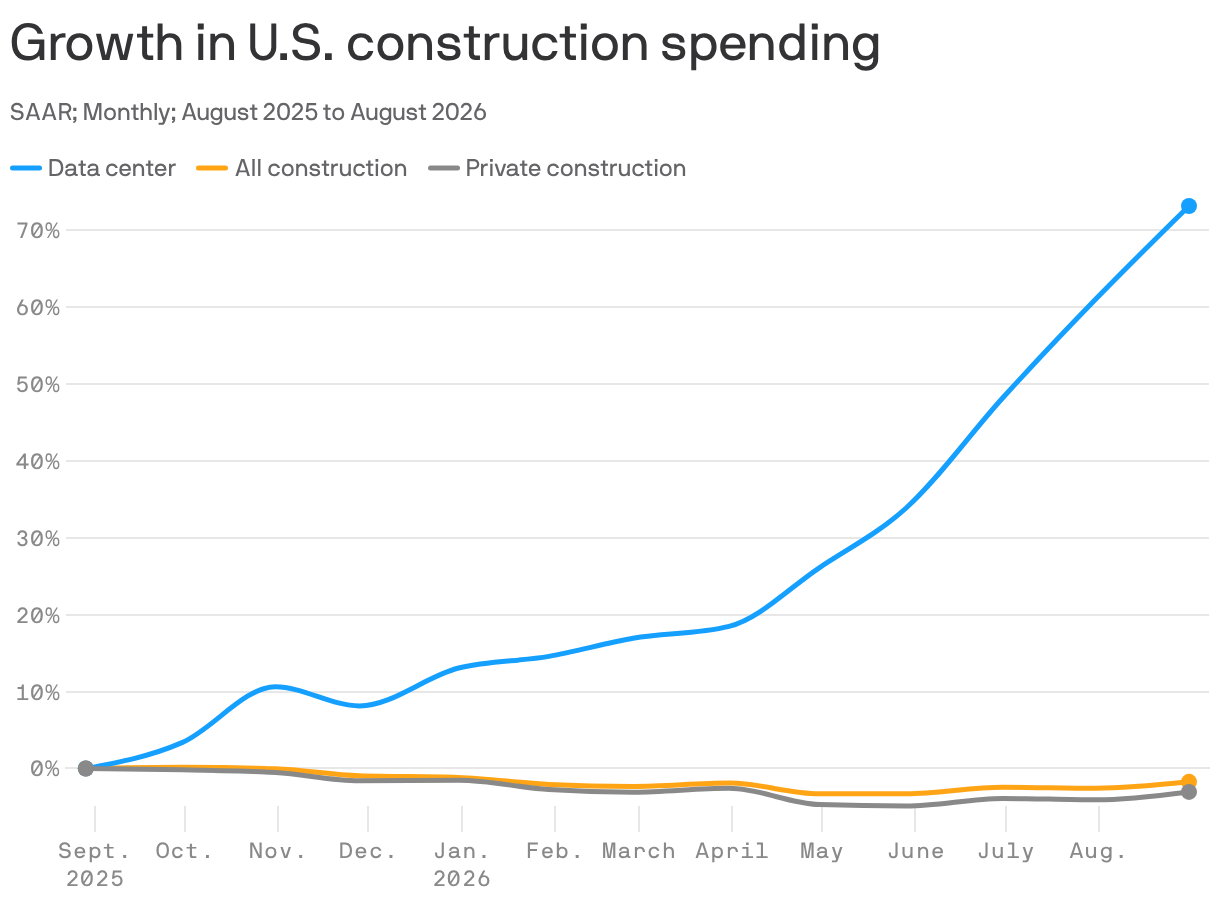
Image via Axios
AI stocks surge while the broader economy sends mixed signals
A widening gap is opening between the AI-fueled corner of the market and several bread-and-butter measures of the real economy. Recent data points show strong momentum in AI-linked equities and continued heavy investment in data-center construction, even as interest rates, bond-market signals, and parts of the labor picture point to a less exuberant underlying pace.
One reason the split matters is that it changes what “the economy” looks like depending on where you stand. Investors concentrated in mega-cap tech and AI beneficiaries have seen strength that masks softness elsewhere, while households and small businesses feel a higher-rate environment more directly through borrowing costs, rent, and slower hiring in rate-sensitive sectors.
The risk is not that AI investment is fake, but that markets can overprice a theme while underpricing the drag from tighter financial conditions. If growth cools faster than expected, the parts of the market priced for perfection will have less room for error, and policymakers will face a familiar challenge: parsing headline resilience from uneven fundamentals.
✓ The Bottom Line: The evidence still supports the idea that AI is a real productivity and capex story, not just a trading fad. But when a narrow set of winners carries the indexes, it can lull investors and voters into thinking the broader economy is stronger than it is. A healthy read is both things can be true at once: AI is booming, and the average economy is bumpier.
📎 Axios

Image via The Hill
Trump targets Abdul El-Sayed after Michigan Senate debate as race turns more national
President Trump attacked Democratic Michigan Senate candidate Abdul El-Sayed after Thursday’s debate, elevating what had been a state-focused contest into a more nationally framed fight. The debate featured El-Sayed against Republican former Rep. Mike Rogers, with each side arguing the other would be a rubber stamp for party leadership.
Trump’s intervention signals the GOP wants Michigan to be a marquee battleground, tying Democratic candidates to national party brands on inflation, immigration, and cultural issues. Democrats, meanwhile, will argue that Rogers represents a return to establishment politics and that Trump’s involvement underscores how much is at stake for control of the Senate.
The practical implication is that the campaign is likely to get louder and less local. Expect more outside money, sharper messaging on national flashpoints, and less oxygen for the state-level concerns voters often cite first — costs, jobs, and public safety.
✓ The Bottom Line: Trump’s instinct is to define the opponent early and force the race onto national terrain, and it can be effective in a polarized electorate. But it also risks making the contest a referendum on Trump himself in a state where margins are thin and persuadable voters still exist. If Republicans want to win Michigan, they’ll need discipline beyond insults: a credible economic and governance argument that lands with independents.
📎 The Hill
Hurricane Isaias disrupts Gulf oil output, raising stakes for already-tight fuel markets
Hurricane Isaias is disrupting offshore oil and gas production in the Gulf of Mexico and threatens refining operations along the Gulf Coast, a critical hub for U.S. fuel supply. Operators typically shut in production and reduce staffing as storms approach, and even short interruptions can ripple into gasoline, diesel, and jet fuel prices when inventories are not plentiful.
The timing is sensitive. Global energy markets are already strained by conflict-driven disruptions in Eastern Europe and the Middle East, and U.S. consumers have had little patience for renewed price spikes. If refinery throughput drops or shipping lanes face delays, the effect can show up quickly at the pump, especially in regions reliant on Gulf refining capacity.
Beyond immediate prices, storms test the resilience of energy infrastructure that underwrites everything from commuting to freight. Each major weather event reinforces the same policy tension: Americans want reliability and low prices today, while also debating long-term transitions that may not protect them from near-term supply shocks.
✓ The Bottom Line: This is a reminder that energy security is not an abstract slogan; it is operational reality in the Gulf. Policymakers should prioritize redundancy and faster recovery — including permitting and hardening infrastructure — rather than pretending weather risk can be regulated away. The first obligation is keeping the lights on and fuel flowing, even as the country argues about the next decade.
📎 CNBC

Image via ABC News
Russian strikes kill civilians as Ukraine struggles to blunt escalating bombardments
Russian strikes killed two people and wounded five across Ukraine on Friday, according to officials, as Kyiv faces a difficult challenge countering intensified attacks. The latest deaths add to a mounting civilian toll from bombardments that have strained air defenses and pressured frontline logistics.
Ukraine has leaned heavily on Western-provided systems and ammunition to protect cities and critical infrastructure, but Russia’s sustained attacks can overwhelm defenses through volume, varied targeting, and evolving tactics. For Ukraine, the immediate goal is survival and continuity — keeping power, transportation, and government services functioning under repeated stress.
For Europe and the U.S., the developments sharpen a strategic question: whether current levels of assistance match the scale and tempo of the threat. Each week of attritional strikes is not just battlefield math; it is also a test of political will and the credibility of deterrence beyond Ukraine.
✓ The Bottom Line: Russia’s strategy is plainly to wear down Ukraine’s defenses and public morale through sustained pressure on civilians and infrastructure. The West should read that for what it is and respond with practical urgency: air defense, interceptors, and steady resupply, not rhetorical escalation without follow-through. A negotiated end is desirable, but it will not happen on favorable terms if Ukraine cannot protect its cities in the meantime.
📎 ABC News
Senate debates heat up in Georgia, Maine, and Michigan as contrasts sharpen
Senate candidates in Georgia, Maine, and Michigan squared off in a round of heated debates as the midterm campaign enters a more decisive phase. The exchanges highlighted familiar fault lines — inflation and cost of living, abortion, border security, crime, and the role of Washington — while also revealing how candidates tailor national issues to local anxieties.
In battleground states, debates are less about viral moments than about competence signals: command of facts, temperament under pressure, and whether candidates can speak to swing voters without alienating their base. With control of the Senate potentially hinging on a small number of races, both parties are treating these states as high-leverage contests.
The larger takeaway is that persuasion still matters at the margins. Turnout and party loyalty will dominate, but debate performances can shape donor confidence, media narratives, and the small slice of undecided voters who decide close elections.
✓ The Bottom Line: Debates rarely flip races on their own, but they can validate or puncture the case each candidate has been selling for months. In competitive states, the candidate who projects steadiness and a believable economic plan usually gains the most — especially with voters exhausted by national theatrics. The party that treats these contests like job interviews, not social-media auditions, is more likely to win the last few points.
📎 CBS News
That’s the report for Friday. We’ll be watching markets for signs the AI trade is broadening or breaking, the Gulf storm track for refinery impacts, and the Senate map for any post-debate movement heading into the weekend.
— Brief Updates Editorial